Pole-mounted or pad-mounted: the short answer
The mounting type almost never gets chosen on transformer performance. It gets chosen by the service architecture around it. If the medium-voltage feeder runs overhead and the services drop from poles, a pole-mounted unit is the lowest-cost way to step the voltage down, and it will be the default in every rural and semi-rural network. If the medium-voltage feeder is buried, or the transformer stands where the public can reach it, a pad-mounted unit in a locked cabinet is the only option that satisfies both the civil design and the safety case.
The two are not interchangeable at the top end either. A pole unit is practical to roughly 500 kVA in three-phase form; a pad-mounted unit runs from about 45 kVA to several MVA. If your load is above the pole ceiling, the question is closed before cost is discussed. For the liquid-filled side of the range, the oil-immersed power transformer range covers both mounting styles and the ratings behind them.
The difference is the structure, not the core
Both types are distribution transformers. The core, the windings and the oil are doing the same job. What differs is everything around the tank: how the primary is connected, how the unit is protected, how a crew reaches it, and what happens when a member of the public walks up to it.
A pole-mounted transformer is a tank with hangers, bolted to a structure. Its primary is connected through overhead bushings and cutouts, its arrester bracket is part of the installation, and its cooling is whatever the air around the pole provides. Its enclosure is the tank itself.
A pad-mounted transformer is a tank inside a lockable steel cabinet, standing on a poured concrete pad, with the primary terminated on dead-front elbows in a compartment that can be opened without exposing live parts. You are buying the transformer, the cabinet, the switching and fusing compartment, the cable terminations and the civil work.
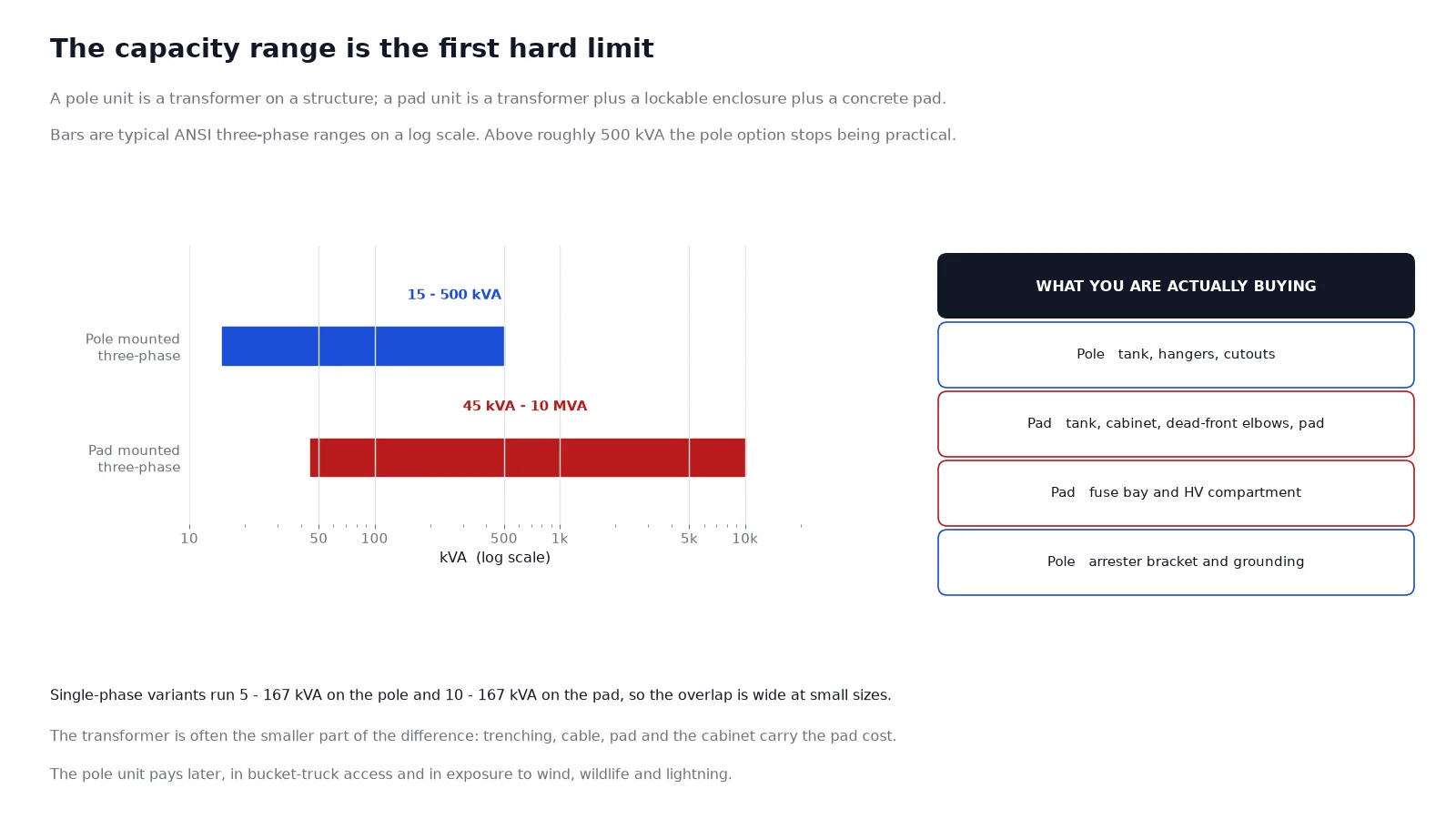
That is why the price gap is smaller than it looks in a quotation and larger than it looks in a budget. The pad unit costs more up front, but a large part of the difference is trenching, cable and concrete that would have been spent elsewhere in a buried network anyway.
Pole-mounted: cheap to install, expensive to reach
A pole unit wins on capital cost and on speed. There is no pad to pour, no trench to dig and no cabinet to land. On a rural feeder with a handful of customers per kilometre, that combination is hard to beat, and it is why overhead construction remains the default in low-density territory.
The costs arrive later, and they are operational rather than capital. Every inspection and every repair needs a bucket truck and a crew working at height. Thermal imaging, oil sampling, fuse replacement and bushing inspection all take longer than the same job on a pad. The unit is also fully exposed: wind loading on the tank and bushings, wildlife contact on the primary leads, direct lightning exposure on the arrester and the tank, and mechanical damage from storm debris.
None of that makes a pole unit a bad choice. It makes it a choice with a different cost curve, and the crossover usually sits where the number of services per transformer rises or where the local code stops allowing new overhead distribution in a residential development. The existing pole-mounted range and its ANSI construction detail are described on the pole-mounted power line transformer page.
Pad-mounted: what the cabinet actually contains
A pad-mounted unit is a compartmentalised cabinet, and the compartments are the reason it costs what it costs. A typical three-phase arrangement has a high-voltage compartment with dead-front elbows and a loop-feed or radial configuration, a fuse bay with bayonet or current-limiting fuses, and a low-voltage compartment with the secondary terminals and the neutral.
That layout gives you three things a pole unit cannot. First, the primary can be switched and earthed at ground level with the cabinet closed, which is what makes loop-feed operation and back-feeding practical. Second, fault clearing is local: a bayonet fuse isolates a failed unit without tripping the feeder. Third, the live parts are behind barriers and interlocks, so the equipment can stand on a sidewalk, in a car park or beside a school.
The cabinet is not a cosmetic item either. Enclosure integrity, locking and the resistance of the door and hinges to deliberate damage are covered by ANSI C57.12.28, and the dead-front interfaces by IEEE 386. A quotation that offers a “pad-mounted” unit in a plain weatherproof box without those references is offering a different product.
| Attribute |
Pole mounted |
Pad mounted |
| Typical three-phase range |
15 to 500 kVA |
45 kVA to several MVA |
| Typical single-phase range |
5 to 167 kVA |
10 to 167 kVA |
| Primary connection |
Overhead bushings and cutouts |
Dead-front elbows, loop or radial feed |
| Protection |
Cutout and arrester |
Bayonet or current-limiting fuse, arrester, fault indicator |
| Public interface |
Tank at height, primary exposed |
Locked cabinet, live parts behind barriers |
| Access for maintenance |
Bucket truck and line crew |
Ground level, walk-up |
| Civil work |
Pole and anchors |
Concrete pad, trench and cable |
| Exposure |
Wind, wildlife, lightning, debris |
Shielded, but needs drainage and ventilation |
| Typical standards |
ANSI/IEEE C57.12 series, IEC 60076 |
ANSI C57.12.34 or C57.12.38, IEEE 386, C57.12.28 |
Capacity, voltage and the numbers that travel with the type
The ratings tend to move together with the mounting choice, which is useful because it lets you sanity-check a specification quickly. Pole units cluster in the smaller ratings at 2.4 to 34.5 kV primary, with 120/240 V split-phase secondaries on the single-phase units. Pad units cover a wider band, up to 46 kV primary and secondaries such as 208Y/120 V and 480Y/277 V.
For a 10 kV or 11 kV distribution network built to IEC rather than ANSI, the same logic applies with different numbers. The transformer is commonly a 10/0.4 kV or 11/0.4 kV unit with a Dyn11 vector group, and the “pad” version is often a European-style enclosure that also houses the medium-voltage switchgear and the low-voltage panel. The oil-immersed distribution transformer range covers 25 to 2,500 kVA at 10, 11, 20, 30 and 33 kV with losses, impedance and tap range fixed at order.
Where the cost difference actually sits
Two projects with the same kVA can differ by a factor of three on installed cost, and the transformer is rarely the reason. On the pole side the extra items are the structure, the guys and anchors, the cutouts, the arrester bracket and the grounding, plus the bucket-truck time for the connection. On the pad side they are the pad, the trench, the medium-voltage cable, the elbows and the terminations, and the cable pulling itself.
The honest comparison is the cost per served customer over the life of the asset, not the cost per kVA. A pad unit serving forty apartments and a pole unit serving four farmhouses are not in the same comparison, even if the nameplate ratings are close. Cooling also changes with the enclosure: a sealed cabinet holds heat in, so the same tank may need a higher cooling class or a lower rating for the same ambient, and the reasoning is in our guide to ONAN and ONAF cooling classes.
Public safety is a specification, not a preference
Where a transformer stands on private ground behind a fence, exposure is an operational question. Where it stands on a public footpath, it is a code question, and the code usually names the standard. For pad-mounted equipment in North America, tamper resistance is addressed by ANSI C57.12.28 and the dead-front connection interface by IEEE 386. Where the unit sits close to a building, NEC Article 450 governs ventilation, vault construction and working space.
The pole unit avoids the public interface by putting the tank out of reach, which is a legitimate solution but a fragile one. Bushings, jumper leads and arresters remain exposed to contact from ladders, machinery and vegetation, and the clearance envelope has to be maintained for the life of the installation, not just at commissioning.
The third option most buyers forget
Between the pole unit and the American-style pad unit there is a European-style compact substation: a single enclosure containing the medium-voltage ring main unit, the transformer and the low-voltage distribution board. It occupies a footprint similar to a pad unit but moves the switching and protection indoors, which shortens the medium-voltage cable and removes a separate RMU foundation.
It is usually the right answer where the load is commercial rather than residential, where the developer wants one asset instead of three, and where the local utility allows the medium-voltage switch to sit inside the customer’s enclosure. It costs more than a pad unit per kVA at small ratings and less than a pad plus a separate RMU at larger ones.
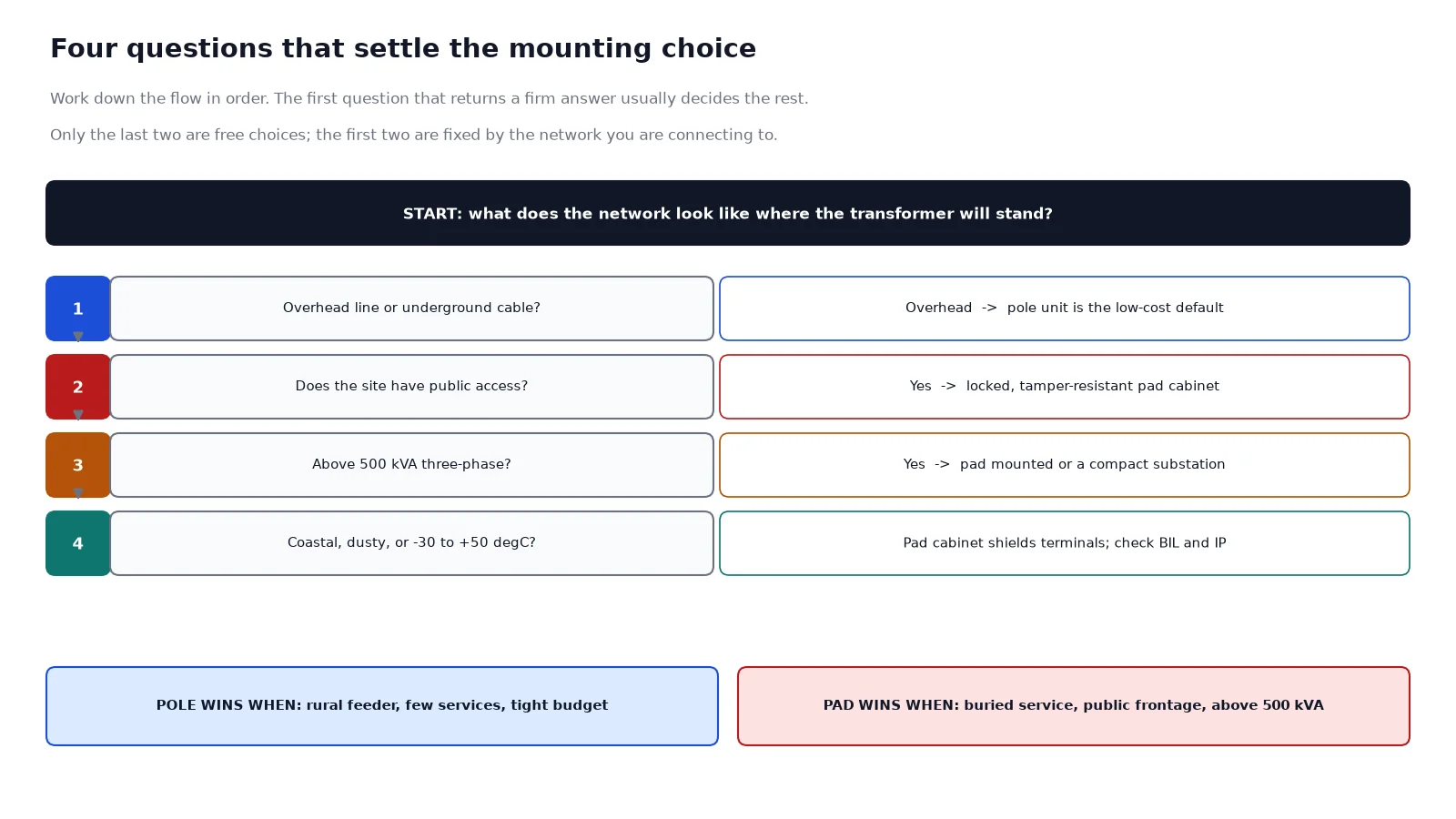
Four questions that settle it
Work through these in order. The first one that returns a firm answer usually decides the rest.
- Is the feeder overhead or underground? Overhead points to pole; buried points to pad.
- Can the public reach the unit? If yes, the cabinet, the locking and the dead-front interface are mandatory.
- Is the three-phase load above 500 kVA? Above that the pole option stops being practical and the choice is pad or compact substation.
- What is the environment? Coastal salt, desert dust and -30 to +50 degrees C all push toward a sealed cabinet, with the BIL and ingress protection stated explicitly.
Sizing comes after mounting, not before. If the capacity is still open, the load calculation method in our transformer sizing guide will get you to a rating, and the mounting type then follows from the network.
What to put in the inquiry
State the mounting type, the number of phases, the rated capacity, the primary and secondary voltages, the vector group, the tap range, the impedance, the cooling class, the ambient and altitude, the pollution or ingress level, and the applicable standard. Add the primary fault level if a fuse has to be sized, and the loop-feed or radial arrangement if the unit is pad mounted.
For anything above 33 kV, or where the local class is not an IEC standard value, say so rather than rounding. A 35 kV feeder is a different build from a 33 kV one, and the difference is settled at quotation rather than at delivery. The 35 kV oil-immersed selection guide covers that boundary in detail.
FAQ
Can a pole-mounted transformer be installed at ground level?
Only as a different product. The tank, hangers and bushings of a pole unit assume overhead connection and free air on all sides. Setting one on a plinth removes the cooling and the clearances it was designed around.
What is the largest three-phase pole-mounted transformer?
Around 500 kVA in practical ANSI three-phase terms, and that already needs a two-pole platform. Single-phase units top out near 167 kVA.
Is a pad-mounted transformer always oil filled?
No. Liquid-filled units are the majority, but cast-resin dry-type units are used in pad-mounted arrangements where oil is not acceptable, for example inside a building line or where spill containment is impractical.
Do pad-mounted transformers need ventilation?
The cabinet does. A sealed enclosure traps heat, so the cooling class and the ambient inside the cabinet have to be checked, not assumed to match the open-air rating.
Why is a bayonet fuse used in pad-mounted units?
Because it can be replaced from outside the tank without opening the high-voltage compartment, which is what allows a failed unit to be isolated at ground level while the feeder stays energised.
Which standard applies to the enclosure?
For North American pad-mounted equipment, ANSI C57.12.28 covers enclosure integrity and tamper resistance, C57.12.34 covers three-phase pad-mounted units and C57.12.38 the single-phase ones, with IEEE 386 for the separable connectors.
The practical summary
Choose the pole when the feeder is overhead, the load is small and the unit can stay out of public reach. Choose the pad when the feeder is buried, the load is large, or people can walk up to it. Then spend the effort on the parts that decide whether the unit lasts: the cooling class in its real ambient, the fuse or breaker coordination, the grounding, and the corrosion system for the site. Those four items cause more early failures than the mounting type ever will.