The transformer in the basement is 34 years old, it passes its oil tests, and nobody can say whether it will last another decade or fail on the hottest afternoon of next summer. That is the normal state of a decision most facilities defer until it is made for them — usually at 2 a.m., at premium cost, with a temporary unit on a truck.
Transformer replacement is really three decisions stacked on each other: whether to replace at all, whether to replace like-for-like or with a different technology such as a dry-type unit, and how to keep the building powered during the swap. Getting the first one wrong wastes money; getting the third wrong costs a shutdown.
When replacement beats repair
Repair assumes the active part is worth saving. That is a question about the paper, not about the damage — the mechanisms that destroy it are set out in our analysis of power transformer failure causes. A winding failure, a burnt tap changer or a ruptured bushing can all be repaired, but if the cellulose insulation around the conductors is at the end of its life, the repair returns a unit that will fail again on the next through-fault.
So the decision rule is: assess the insulation first, then look at the damage.
| Evidence |
Reading |
Implication |
| Degree of polymerisation (DP), from a paper sample |
New 1,000–1,200; 400–600 moderate ageing; 250–400 severe; below 250 end of life |
Below 250, repair is not worth the labour |
| Furan (2-FAL) in oil |
Below 0.1 mg/L in new oil; above roughly 4 mg/L indicates DP below 250 |
Above 4 mg/L, plan replacement; a repair buys months |
| Furan after 20 years |
Above 0.75 mg/L suggests the unit is ageing faster than its age |
Look for a thermal or moisture cause before deciding |
| Acetylene in DGA |
Any sustained presence means arcing |
An internal inspection decides; often a replacement |
| No-load loss against a modern design |
A 30-year-old core can lose 30–40 % more than a current efficiency class |
Loss capitalisation alone can justify replacement |
| Repeated protection operations, rising temperature at constant load |
Degrading cooling or increasing losses |
Investigate before condemning the winding |
One caution about furan: the number is only meaningful if the oil history is known. If the oil was replaced or reclaimed, the measured value understates the paper ageing and needs a correction. Reading a single furan result without the oil history is how healthy units get scrapped.
Three routes, not two
Owners usually frame the choice as repair or replace. There is a middle route, and for a specific set of cases it is the best value.
- Repair or rewind. Appropriate when the fault is local, the paper is healthy (DP above 400), and the unit has a long outage tolerance. A rewind also allows an insulation upgrade and a loss improvement, at 40–60 % of a new unit’s cost.
- Retrofit. Keep the tank, the bushings, the plinth and the cable terminations; replace the active part, upgrade the cooling, and add monitoring. This is what “retrofit” means in the strict sense, and it exists mainly for large power transformers where the civil and connection work dominates the cost.
- Replace. A new unit, possibly of a different technology. For distribution ratings this is usually cheaper than a retrofit once the outage, the transport and the warranty are counted.
The word retrofit gets used loosely in the market — often it means “replace the old oil unit with a dry-type unit in the same room”. That is a replacement, and it is the most common project in this category. What it requires is a careful dimensional match, which is the next section.
The dimensional and electrical checklist
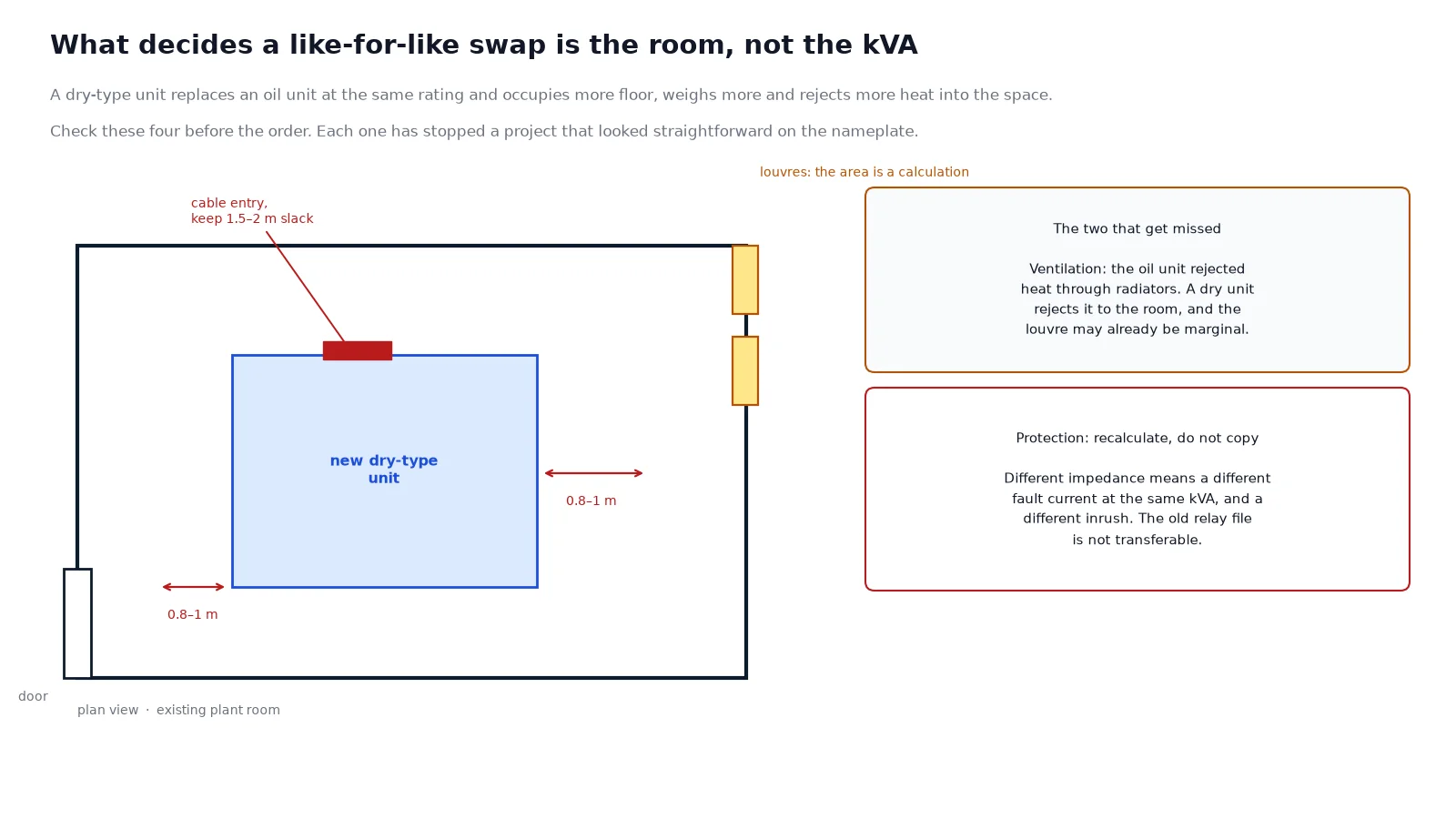
Replacing a 1,000 kVA oil unit with a 1,000 kVA cast-resin unit in an existing room is not a like-for-like swap. Seven parameters decide whether it fits and whether the protection still works.
| Parameter |
Why it decides the project |
| Footprint and height |
A dry-type unit at the same rating is typically larger; the room may need a door widened or a wall moved. Check the dimension chart before ordering, not after. |
| Weight and floor loading |
Dry type is usually heavier for the same kVA. The plinth and the slab may need assessment, particularly on an upper floor. |
| Impedance |
If the new unit runs in parallel with an existing one, impedance must match within roughly ±7.5 %, and the kVA ratio should not exceed about 3:1. |
| Vector group |
Dyn11 must stay Dyn11 for parallel operation. A change of vector group changes the phase relationship and the earth-fault behaviour. |
| Cable entry and termination |
Top or bottom entry, cable box position, and whether the existing cables have the length and bending radius to reach the new terminals. Cable shortening is not reversible. |
| Ventilation |
A dry-type unit rejects more heat to the room. The existing louvre area may be adequate for the old oil unit and inadequate for the new one — the room temperature rise is a calculation, not an opinion. |
| Protection settings |
Different impedance and inrush means different settings. Recalculate; do not carry the old relay file across. |
Two of these are routinely missed. The ventilation check is missed because the old unit’s heat went out through the radiators and the room was never calculated at all. The protection recalculation is missed because the relay settings live in a different department from the transformer purchase.
Speed: the emergency replacement case
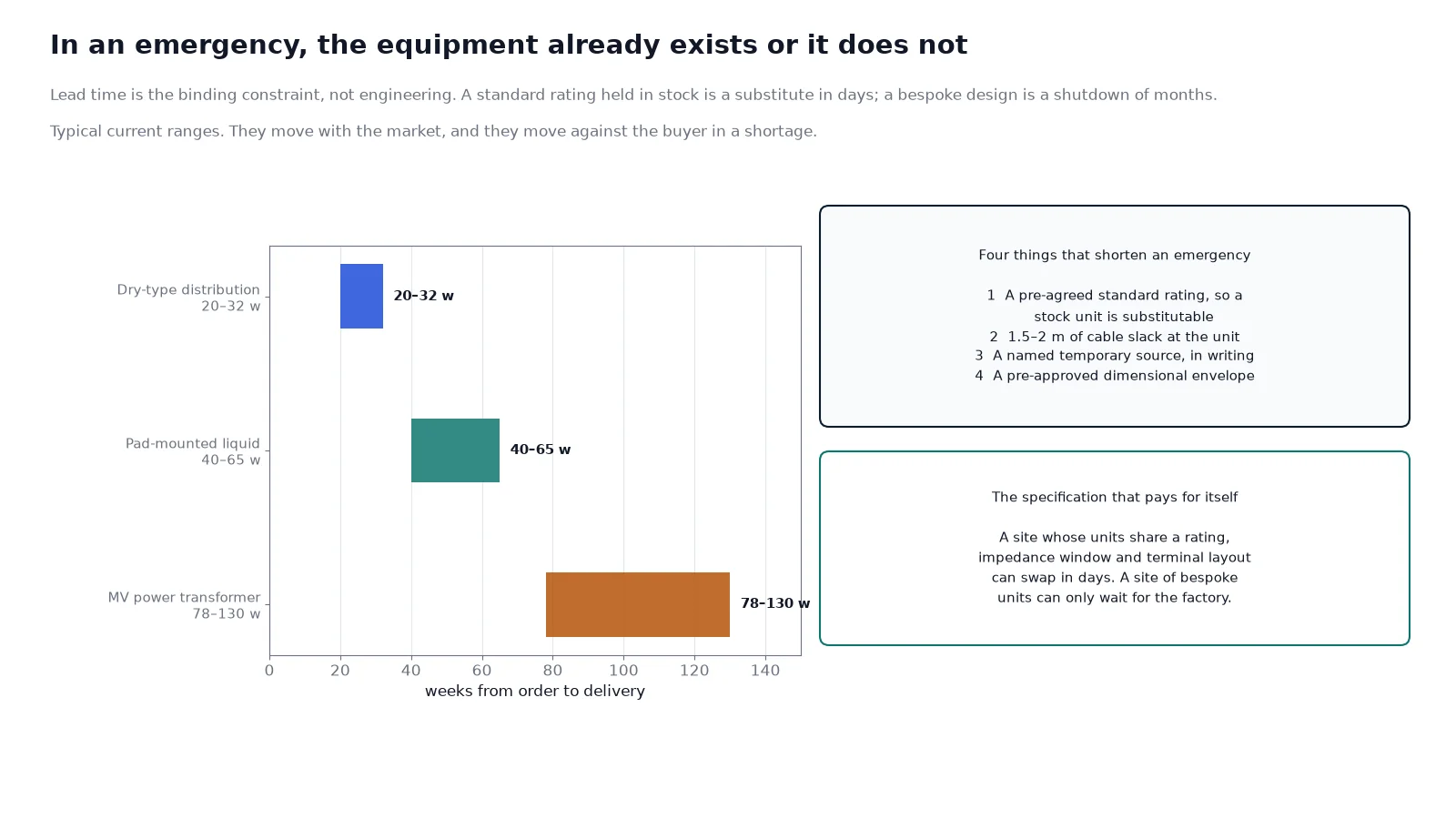
Emergency replacement is a different discipline from planned replacement. The engineering is the same; the constraint is that the unit has to exist. Lead times in the current market make that the binding problem: dry-type distribution transformers typically run 20–32 weeks, pad-mounted liquid units 40–65 weeks, and large power transformers far longer.
Four things shorten an emergency.
- A pre-agreed standard rating. If the site’s units are all 1,000 kVA Dyn11 with the same impedance and the same terminal arrangement, a stock unit can be substituted in days. If every unit is bespoke, nothing is substitutable.
- Cable length allowance. Keep 1.5–2 m of slack in the LV and HV cables at the transformer. This single detail, decided by an electrician twenty years ago, decides whether a substitute unit can be connected without splicing.
- A named temporary source. A rental mobile substation, or a spare unit held by the manufacturer, or a documented plan to run the critical load from a generator. Pick one and write it down.
- Pre-approved dimensional envelope. Know the maximum footprint, weight and height the room or bay can accept, so a substitute does not need a civil survey during the outage.
Practical procurement note: ask for the delivery of a standard rating with a defined impedance window rather than a fully custom design, and keep the specification on file. The technical data sheet is the document an emergency buyer actually needs, because it can be matched against a stock unit field by field.
Changing technology: oil to dry type
The most common retrofit in occupied buildings is the replacement of an indoor oil-filled unit with a cast-resin one, and the driver is usually fire code rather than engineering. An indoor oil unit above a certain rating typically requires a fire-rated compartment or a vault; a dry-type unit with an F1 fire class usually removes that requirement for the transformer itself.
Three consequences need to be priced in.
- Cost per kVA rises, typically 20–40 % over the oil equivalent at distribution ratings.
- Losses rise at the same efficiency class, and the heat goes into the room, which may need mechanical ventilation that the oil unit did not.
- Overload margin falls. Oil has thermal mass and a higher permissible rise; a dry-type unit has less short-time overload capability. If the site relies on riding through peak loads, that needs checking against the size and dimension data and the manufacturer’s overload curve.
The upside is that the vault, the oil containment, the fire suppression and the oil disposal cost all disappear, and the room can often be reused for something else. In a basement plant room, that arithmetic frequently favours the dry-type replacement even at the higher equipment price.
Changing voltage, not just kVA
Network voltage changes are the second retrofit driver: an 11 kV site re-fed at 13.8 kV, a plant moving from 6.6 kV to 11 kV, a new supply agreement with a different nominal. The transformer is often the cheapest part of that change — the switchgear, the protection and the cable ratings are usually the larger items — but three transformer-specific points matter.
First, the insulation level follows the new system voltage, not the old one. Second, the taps must be specified for the new nominal with the required regulation range, since an 11 kV winding with ±5 % taps cannot cover a 13.8 kV supply. Third, the short-circuit duty on the LV side changes with the new ratio, so the LV equipment rating has to be rechecked.
What to put in the enquiry
An accurate replacement enquiry is short, and it is almost entirely documentary.
- The nameplate photograph, readable, including the vector group, impedance and tap range.
- Site conditions: ambient, altitude, indoor or outdoor, enclosure type required, and the available footprint with clearances.
- The existing protection scheme and settings, plus the fault level at the point of connection.
- Whether the new unit will run in parallel with anything, and if so, that unit’s impedance and vector group.
- The outage window, and whether a temporary supply exists.
With those five items a manufacturer can quote a compliant unit rather than a generic one. Our note on auditing a transformer manufacturer covers what to verify before the order, and the commercial side — MOQ, lead time and the payment structure for a single replacement unit — is set out in our guide to MOQ and lead time.
Frequently asked questions
How long does a transformer last before it needs replacing?
Design life is normally 25–40 years, based on paper ageing at a 98 °C hot spot under a normal load cycle. Actual life is set by loading, cooling and moisture: units that run cool and dry reach 40 years; units that run hot and wet fail at 15–20 with no design defect.
Can a transformer be repaired instead of replaced?
Yes, if the insulation is still sound. A local fault in a unit with DP above roughly 400 and a low furan level is a repair candidate, typically at 40–60 % of a new unit’s cost. If DP is below 250, a repair returns a unit that will fail again on the next through-fault.
What is the lead time for a replacement transformer?
Roughly 20–32 weeks for a dry-type distribution unit, 40–65 weeks for a pad-mounted liquid unit, and considerably longer for large power transformers. Standard ratings with a common impedance are faster than custom designs, which is the practical argument for standardising a site’s units.
Can I replace an oil transformer with a dry-type unit in the same room?
Usually yes, but the footprint, weight and heat rejection all change, and the room ventilation may need upgrading. The fire-rating requirement typically disappears, which is the point of the exercise, but the civil and ventilation work has to be priced before the equipment order.
What must match for two transformers to run in parallel?
The same vector group, the same ratio at the operating tap, impedance within about ±7.5 %, and a kVA ratio no greater than roughly 3:1. The tap positions must also be consistent — a unit on tap 3 and a unit on tap 1 will circulate current between them.
Is a used or refurbished transformer a valid emergency option?
It can be, with conditions: verified impedance and vector group, a DGA and furan baseline, a dielectric test set, and a documented history. The risk is not the electrical design but the unknown insulation condition, which is exactly what the emergency does not allow time to investigate.
The takeaway
Replace on evidence, not on age. Furan and DP tell you whether the paper is spent; a loss comparison tells you whether the unit is expensive to keep; the fire code tells you whether the technology is still allowed in the room. Then design the swap around the three details that actually stop projects — footprint, cable length and ventilation — and keep a standard rating on file so that the emergency version of the same decision costs days instead of months.
If you are planning a replacement, send us the nameplate photo, the room dimensions and the outage window, or contact our engineering desk directly. We will return a dimensional match, the impedance and vector group options, and a delivery date for a standard rating against a custom one, so the comparison is made on installed cost rather than on equipment price.