SCB or SGB: the short answer
For an ordinary 10 kV indoor substation at an ambient of 35 to 40 degrees C, the SCB is the standard answer and the one that will be quoted first. It is a three-phase unit with vacuum-cast epoxy windings and a copper foil low-voltage winding, built from 30 kVA to 2,500 kVA, and it is the cheapest way to get a dry transformer that needs no oil, no vault and no fire-rated room.
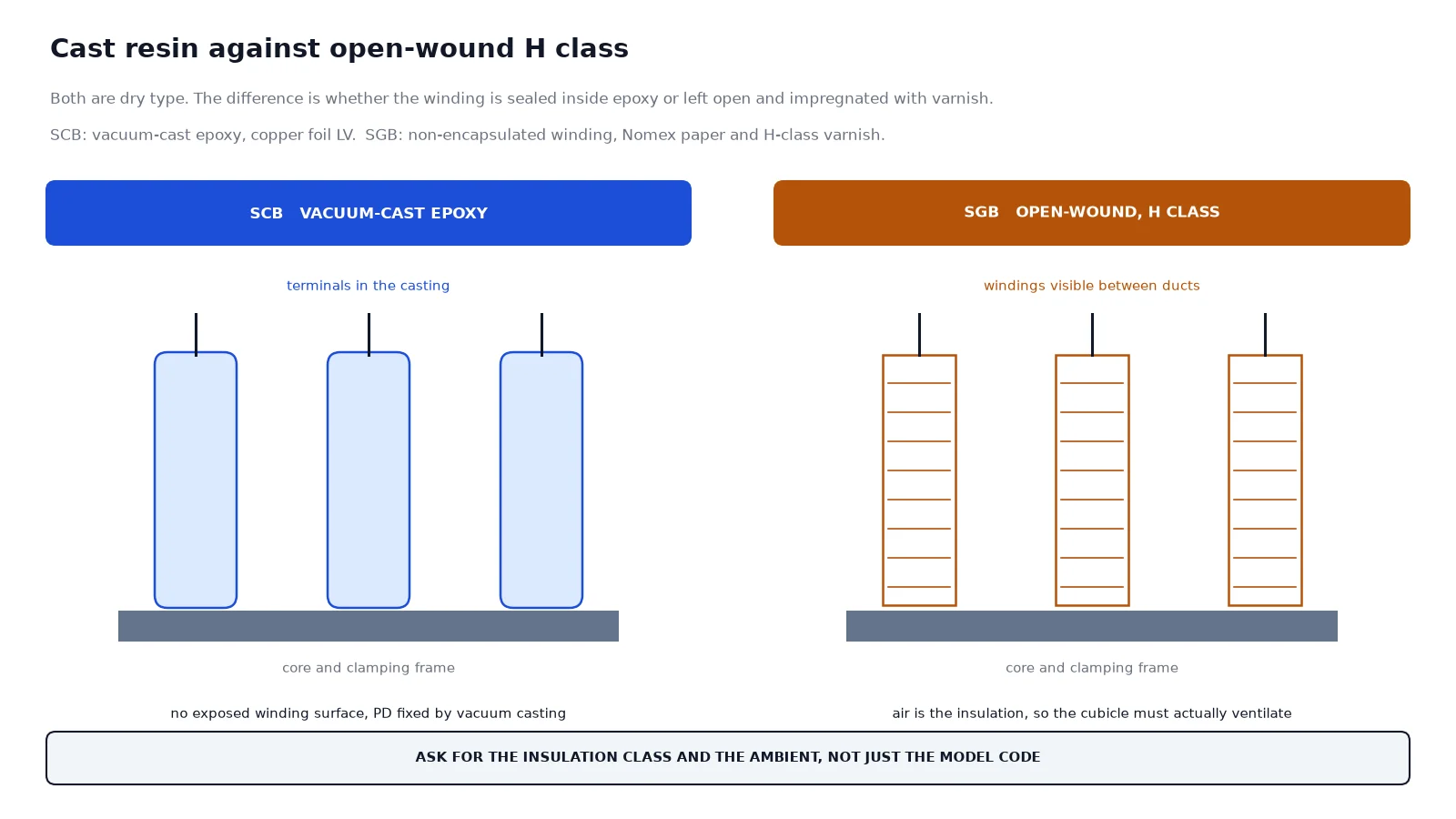
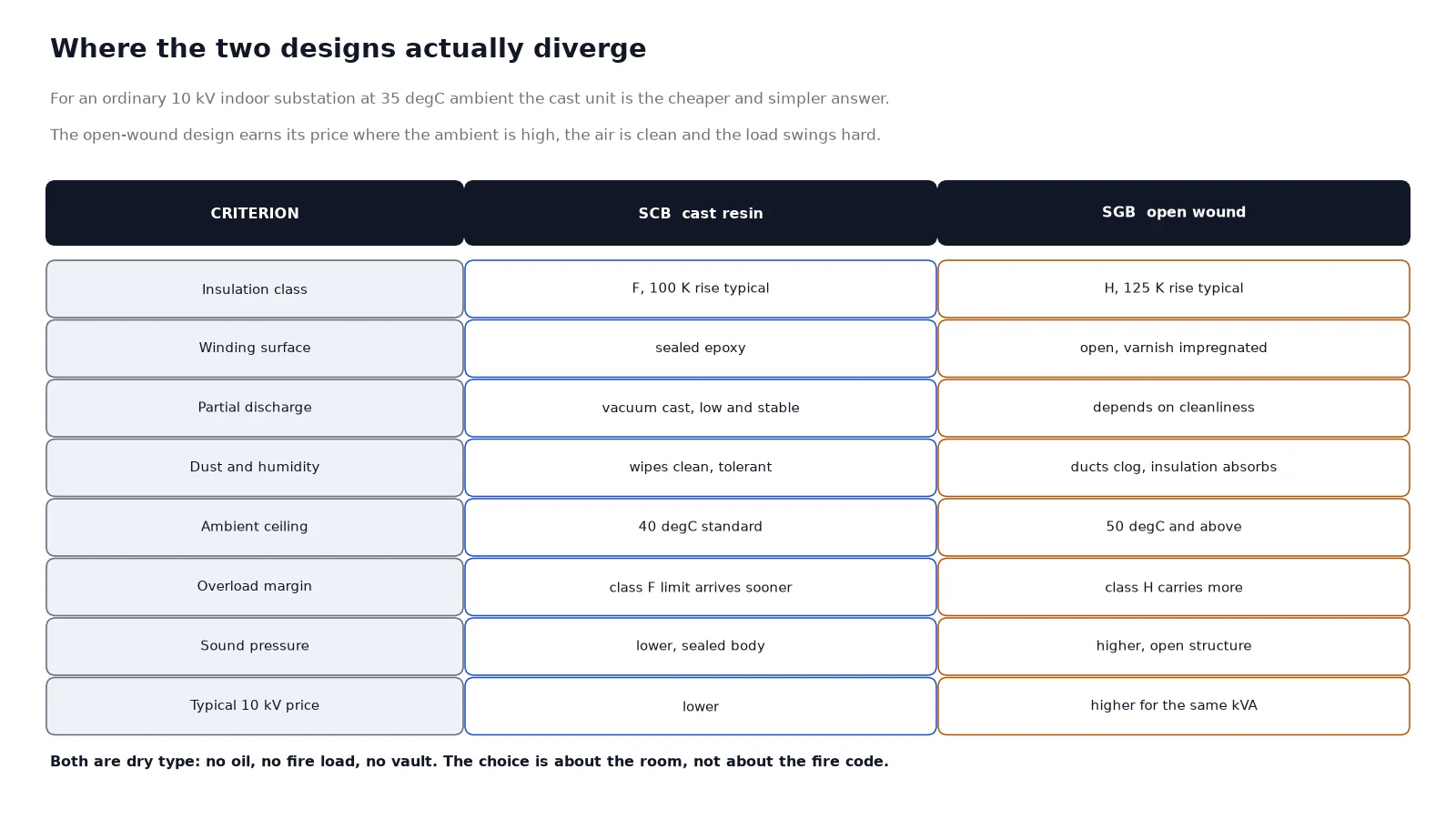
The SGB is not a cheaper or better version of the same thing. It is a different insulation system: the winding is not encapsulated, it is open and impregnated with varnish on an H-class insulation system. That makes it the right choice where the ambient is above the 40 degrees C ceiling the cast unit is built for, where the load swings hard enough that the extra thermal margin pays for itself, and where the room actually ventilates. Choose it where those conditions are real, not because the model code looked similar.
Both are dry type and both belong in the same family, which is why they get confused. The dry type power transformer range lists them alongside the rest of the frames we build.
What the letters actually mean
The Chinese dry-type designation is built from construction letters followed by a performance number and then the rating. Reading it correctly takes about a minute and saves an expensive mistake, because the letters describe how the winding is made, not what the transformer can do.
| Element |
SCB |
SGB |
| S |
Three-phase |
Three-phase |
| C |
Cast resin, solid insulation formed by casting |
Not used |
| G |
Not used |
Dry type, non-encapsulated, air-cooled winding |
| B |
Foil low-voltage winding |
Foil low-voltage winding |
| Number |
Design and loss level, not a voltage |
Design and loss level, not a voltage |
| Slash figure |
Capacity in kVA and high voltage in kV |
Capacity in kVA and high voltage in kV |
So SCB14-1000/10 reads as a three-phase cast-resin unit with a foil low-voltage winding, at the 14 design level, rated 1,000 kVA at 10 kV. An SGB13-1000/10 reads as a three-phase open-wound dry unit at the 13 level with the same rating.
Inside the SCB: vacuum casting and foil
On the cast unit the high-voltage winding is wound and then vacuum cast in epoxy resin. Casting under vacuum removes air from the resin before it cures, and that single step is what keeps partial discharge low for the life of the unit. Voids trapped in a cast winding are invisible after the resin sets and their effect only appears as discharge activity after months in service, which is why process control here matters more than the resin supplier.
The low-voltage winding is copper foil rather than round wire. Foil fills the winding window more completely, which lowers resistance; it behaves as a solid block under short-circuit forces, which raises withstand strength; and it conducts heat out of the winding more evenly along its height. The result is a unit that runs cooler at the same load than a wire-wound equivalent of the same capacity.
The published loss figures for the 10 kV cast range start at 190 W no-load and 710 W load loss for a 30 kVA unit, and reach 3,600 W no-load and 17,170 W load loss at 2,500 kVA with 4 percent impedance. The same 2,500 kVA at 8 percent impedance shows 18,890 W load loss, which is the price of limiting fault current for downstream switchgear. Full tables, tap ranges and vector groups are on the epoxy resin 10 kV dry type transformer page.
Inside the SGB: air as the insulation
The open-wound unit does not encapsulate the winding. The conductor is insulated with a high-temperature film such as Nomex paper, the assembly is vacuum-pressure impregnated with varnish, and the finished winding sits in the air with insulation ducts between sections. There is no epoxy body, so there is nothing to trap heat and nothing to crack.
That construction is what allows the H-class rating. Class H insulation is rated for a 180 degrees C winding temperature with a 125 K allowable rise, against roughly 100 K for a class F cast unit. The practical effect is thermal headroom: the same frame can carry more sustained overload, and it can run in an ambient above 40 degrees C without derating the way a cast unit has to.
The price is that the winding is exposed. Dust collects in the ducts, moisture is absorbed by the insulation rather than kept out by resin, and the cubicle has to move real air through the unit rather than relying on a sealed body to dissipate heat from its surface. In a clean, hot plant room the SGB is excellent. In a humid, dusty basement it degrades faster than a cast unit, and the maintenance that keeps it alive – cleaning the ducts – is the maintenance nobody schedules.
The comparison, side by side
| Criterion |
SCB, cast resin |
SGB, open wound |
| Insulation class |
Class F standard, 100 K rise |
Class H, 125 K rise |
| Winding surface |
Sealed in epoxy |
Open, varnish impregnated |
| Partial discharge |
Low and stable when vacuum cast |
Depends on cleanliness and moisture |
| Dust and humidity |
Wipes clean, tolerant |
Ducts clog, insulation absorbs moisture |
| Ambient ceiling |
40 degrees C standard |
50 degrees C and above |
| Overload margin |
Class F limit arrives sooner |
Class H carries more |
| Ventilation need |
Moderate, surface dissipation |
High, air must pass through the winding |
| Sound pressure |
Lower, sealed body damps it |
Higher, open structure radiates it |
| Relative price at 10 kV |
Lower for the same kVA |
Higher for the same kVA |
The insulation classes behind that table, and how they translate into temperature rise limits and controller set points, are covered in more depth in the dry type transformer insulation series, which is the construction page both frames are built from.
The number after the letters is the loss level
Two units of identical capacity and identical voltage can differ in price by 15 percent because of the number after the letters. On this family the number is the design and loss level, and a higher number means lower losses. SCB10 is an older three-level efficiency design, SCB13 is the common level for ordinary new build, SCB14 is the two-level efficiency design that most tenders now write in, and SCB18 is the one-level design chosen when an energy policy or a green building credit forces the issue.
The decision is arithmetic, not preference. Lower losses cost more up front and pay back at a rate set by your energy price, your load profile and the hours the unit actually runs. Our guide to efficiency classes and loss capitalisation walks through the calculation, and the specific step between the common levels is set out in the SCB10, SCB13 and SCB18 comparison.
Where the SGB earns its price
Three situations justify the open-wound frame, and they are all about heat rather than about price.
- High ambient. A plant room in a hot climate that sits at 45 to 50 degrees C rules out an un-derated class F cast unit. The class H frame runs there without a capacity penalty.
- Heavy cyclic load. A process line that pulls 130 percent for an hour at a time uses up the cast unit’s thermal margin. The class H winding has more of it, and the temperature controller can be set to reflect that.
- Clean air and a real ventilation path. The open-wound design only delivers its advantage if the air moving through it is clean and the cubicle is designed to pass it. Louvres at the bottom and top, a clear path through the winding ducts, and filtration where the air is dirty.
Where none of those apply, the cast unit is cheaper, smaller, quieter and needs less attention. That is the case in most 10 kV indoor substations, which is why the SCB is the default and the SGB is the exception.
Enclosure, cooling and the fan trap
Both frames are offered in natural air (AN) and forced air (AF). AF ratings are conditional: they apply while the fans run, and a unit specified to rely on its AF rating needs fan-failure protection interlocked with the load, or a fan failure quietly becomes an overload. That is as true on a cast unit as on an open-wound one.
Enclosure protection matters more on the open-wound frame. IP20 is finger-safe and standard indoors; IP23 adds protection against water spray and is the usual choice where the room is washed down. On a cast unit the winding itself is sealed, so the ingress rating mostly protects the terminals and the core. On an open-wound unit the rating protects the insulation system, and a higher IP class without a matching ventilation design simply traps the heat the winding needs to shed.
The full set of specification fields – capacity, losses, impedance, vector group, tap range, cooling, enclosure, controller set points – is laid out in the dry type technical data sheet guide. Filling that in before you ask for a price is the difference between one quotation round and four.
When dry type is the wrong family anyway
Dry type exists because oil is a fire load and a containment problem. Inside an occupied building, a basement, a tunnel, a hospital or a data hall, that argument wins and the cost per kVA is accepted. Where the transformer can stand outdoors in a fenced compound, an oil-immersed unit of the same rating is cheaper and carries better overload capability, and choosing epoxy there is paying for a constraint you do not have.
If you are still deciding between cast resin, vacuum-pressure impregnated and open-wound construction as insulation systems rather than as specific model codes, the three-way construction comparison covers that decision without the model numbers.
FAQ
Is SGB better than SCB?
No, they solve different conditions. SGB has more thermal margin and a higher ambient ceiling; SCB is cheaper, quieter, sealed against dust and moisture, and the right default for a normal indoor substation.
Can an SCB be supplied in class H?
Yes, class H is available as an option on cast units. It raises the allowable winding temperature, but it does not change the fact that the epoxy body has to dissipate heat from its surface, so the ambient ceiling improves by less than the class change suggests.
What does the 14 in SCB14 mean?
It is the design and loss level, not a voltage. A higher number in the same family means lower losses and a higher price, so the choice is a payback calculation.
Do I need IP23 on an indoor unit?
Only where the room is washed down or there is water spray. IP20 is the normal indoor specification, and going higher without a ventilation design can trap heat.
Can an SGB run without forced ventilation?
It runs on natural convection, but it needs a real air path through the winding ducts. In a closed cubicle with no low-level inlet and high-level outlet, the winding runs hotter than its class allows.
Which one needs more maintenance?
The SGB, because the ducts have to be cleaned and the insulation kept dry. A cast unit needs a visual inspection and thermography of the connections; the winding itself has nothing to service.
What to order
Start from the room, not from the model code. If the ambient is under 40 degrees C, the air is reasonably clean and the load is steady, specify SCB at the loss level your energy case supports. If the ambient is high, the load cycles hard or the plant runs hot by design, specify SGB with a class H winding and a cubicle that genuinely ventilates. Then fix capacity, impedance, vector group and tap range, and put the ambient and the altitude in the inquiry rather than in the small print.