A marine transformer is not a land unit in a painted box. It runs at 45 °C ambient with 95 % relative humidity, breathes air laced with salt, rolls 22.5° and trims 15°, and does all of that without a maintenance crew available for a week at a time. The electrical duty is usually modest — 50 kVA to 3 MVA on most commercial vessels — but the environmental duty is severe enough that the design, the enclosure and the approval paperwork all diverge from an ordinary IEC 60076 unit.
The governing document is IEC 60092-303, applied together with the rules of the classification society that will survey the ship: CCS, DNV, ABS, Lloyd’s Register, BV, NK or KR. A transformer that satisfies IEC 60076-11 but has no class certificate is not installable on a vessel, and that distinction — certification, not specification — is where most first-time marine purchases go wrong.
Why the marine specification diverges
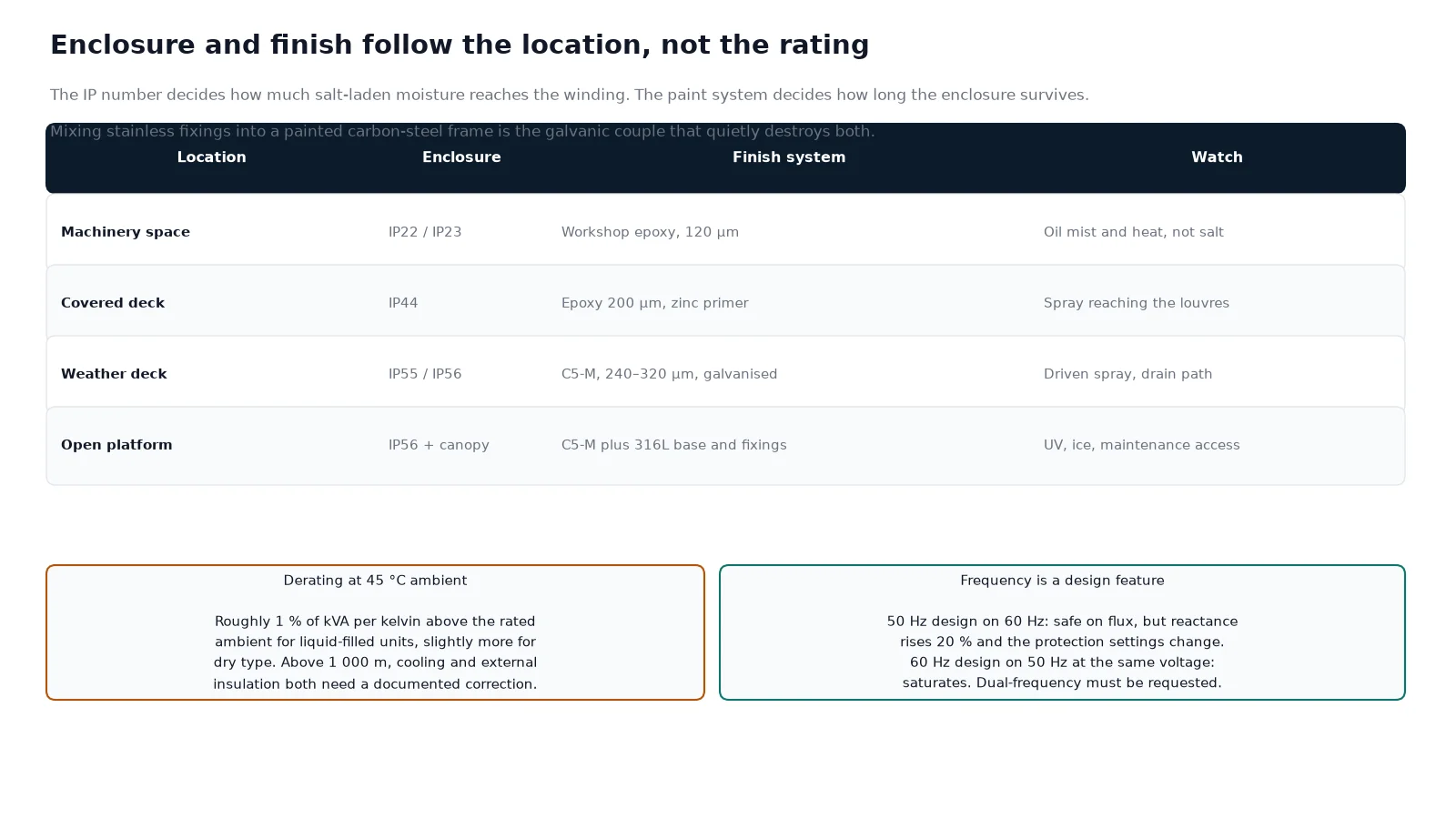
Four conditions separate the marine duty from an industrial one, and each drives a specific design decision.
- Salinity. Salt deposits on insulation surfaces are conductive and hygroscopic. A contaminated creepage path tracks at a fraction of the dry flashover voltage, so clearance alone does not protect the unit; the enclosure and the finish do.
- Condensation. A transformer that cools overnight in a machinery space sitting at dew point will wet its own surfaces. Sea air at 95 % RH leaves very little margin between ambient and dew point, so anti-condensation heaters are not an optional accessory — they are the difference between a dry winding and a tracking failure.
- Vibration and inclination. Continuous machinery vibration loosens clamping and frets insulation. Inclination is the reason liquid-filled units need careful oil-level and alarm design: under 22.5° roll, oil moves to one end of the tank and the top of the winding can be exposed.
- No maintenance window. A unit that needs an annual oil sample is a planning problem at sea. It is one reason class rules prefer air-cooled dry-type transformers for auxiliary duty.
What IEC 60092-303 and the class rules require
The standard sets the electrical requirements; the class rules add the approval route, the enclosure minima and the alarm philosophy. The temperature-rise limits are the numbers that most often decide whether a proposed design is acceptable.
| Parameter |
Limit |
Consequence for the design |
| Winding temperature rise, dry type, Class F |
95 K |
Class H (120 K) is available but buys margin by spending insulation life; Class F with a H-class insulation system is the usual marine compromise |
| Winding temperature rise, dry type, Class H |
120 K |
Allows a smaller core and a higher losses unit; check the space and cooling first |
| Liquid-filled, ON |
65 K |
Thermometer method; the oil temperature gauge is a surveyed instrument |
| Liquid-filled, OD |
70 K |
Forced cooling; the pump becomes a single point of failure |
| Short-circuit withstand |
2 s at winding terminals |
Bracing and clamping must be demonstrated by test, not assumed from a land design |
| Enclosure, above 1 kV |
IP23 minimum |
IP4X where unqualified persons have access; IP44 to IP56 for deck and weather deck locations |
| Ambient design basis |
45 °C, 95 % RH, 1,000 m |
Above 45 °C or 1,000 m the unit must be derated, not merely relabelled |
The dielectric test levels are lower than a land transmission unit of the same voltage class, because marine systems are impedance-earthed or isolated and the surge environment is bounded by the vessel’s own distribution. A 12 kV winding is tested at 28 kV AC for one minute; the pattern follows 3.6 kV at 1.1 kV, 20 kV at 7.2 kV, 38 kV at 17.5 kV, 50 kV at 24 kV and 70 kV at 36 kV.
Dry type or liquid filled on board
Most class rules state a preference for air-cooled dry-type transformers. That preference is well founded, but the choice is not automatic.
| Criterion |
Cast-resin or VPI dry type |
Liquid filled |
| Fire and smoke |
No liquid fuel; F1 class available |
Requires oil containment, alarms and a surveyed tank |
| Inclination behaviour |
Insensitive to list and trim |
Oil level and Buchholz behaviour must be assessed for 22.5° roll |
| Salt and humidity |
Resin-encapsulated, tracking-resistant; enclosure and heaters still required |
Tank and bushings need C5-M finish and sealed breathers |
| Size at 1 MVA |
Larger footprint, higher no-load loss |
Compact, lower loss, cheaper per kVA above roughly 2 MVA |
| Maintenance at sea |
Inspection and cleaning only |
Oil sampling, breather, gaskets, level alarms |
| Best fit |
Auxiliary, lighting, deck machinery, shore connection step-down |
Large propulsion and bow-thruster supply where space dominates |
For a 6.6 kV or 11 kV shore connection stepping down to 440 V, a cast-resin or VPI winding inside an IP44 steel enclosure is the standard answer. For a 3 MVA propulsion supply, the oil-filled unit is still usually lighter and smaller, and the class society will accept it once the alarms and the tank are right.
Enclosure and finish: the part that decides service life
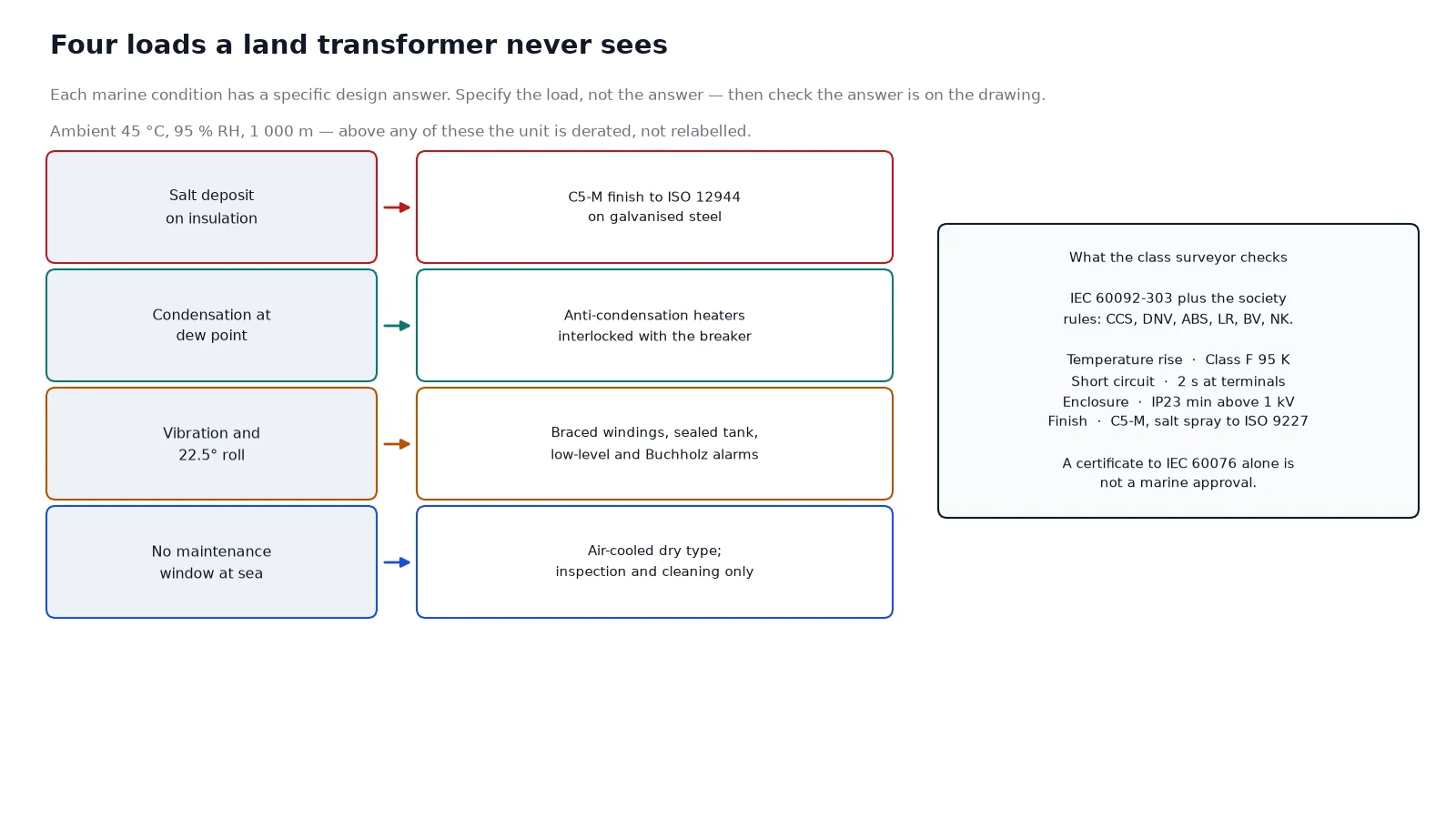
Two enclosure families cover most of the fleet. A drip-proof steel enclosure at IP22 or IP23 ventilates freely and is appropriate inside a machinery space or a covered deck. A sealed epoxy-encapsulated or resin-cast unit at IP55 or IP56 suits a weather deck or an open location, where driven spray reaches the equipment.
The finish specification matters as much as the IP number. Offshore and deck-mounted units are normally specified to corrosivity category C5-M under ISO 12944: hot-dip galvanised steel, a zinc-rich primer, and a multi-coat epoxy system with a total dry film thickness in the 240–320 µm range, verified by salt-spray testing to ISO 9227. A standard workshop paint system will look sound for two years and then fail at the weld seams and the enclosure base, which is exactly where water sits.
Stainless steel 316L is the alternative where the budget allows, particularly for the enclosure base, the lifting eyes and the terminal box. Mixing stainless fixings with a painted carbon-steel frame is the classic galvanic couple that quietly destroys both. Where the same vessel also carries process plant, the deck machinery duty is closer to our oil and gas transformer range than to a utility distribution unit, and the enclosure logic transfers.
Derating for a 45 °C machinery space
A transformer rated at 40 °C ambient and installed in a 45 °C space is running five kelvin closer to its limit than the design assumed. For liquid-filled designs the practical derating is roughly 1 % of kVA per kelvin above the rated ambient, so 5 K costs about 5 % of rating. Dry-type units have a smaller winding margin and derate a little faster.
Altitude is the second correction. Above 1,000 m the reduced air density weakens both cooling and external insulation, and a unit specified for a mountain site needs a documented correction rather than a verbal assurance.
Frequency is the third. A 50 Hz design operated at 60 Hz at the same voltage is safe on flux — the volts-per-hertz ratio falls — but its reactance rises by 20 %, which reduces short-circuit current and changes the protection settings that were calculated for 50 Hz. A 60 Hz design operated at 50 Hz at the same voltage saturates the core, overheats the laminations and will fail. Dual-frequency nameplates exist, but they are a design feature and must be requested, not assumed.
What the class society will ask for
Approval is a documentation exercise as much as a technical one. The submission normally consists of the type-test report, the routine-test report for the individual serial number, the winding-material declarations, the enclosure IP certificate and the finish system data. Class rules also control the supplier of the electrical steel and the winding conductor: changing either without approval invalidates the certificate.
Routine tests are unremarkable — winding resistance, ratio, impedance, insulation resistance, applied and induced voltage, and a temperature-rise check where the rating is large enough to warrant it. The type test is where the marine content lives: the vibration sweep, the inclination demonstration and, for liquid-filled units, the alarm and trip functions under simulated low level and high temperature.
Practical advice from the procurement side: confirm the class society and the notation before the order, not during the survey. A unit built to CCS rules cannot simply be re-certificated by DNV afterwards, and re-testing on the quay is the most expensive way to discover that. It also helps to agree the winding system early — the difference between cast resin, VPI and open-wound construction is what decides how the unit behaves in salt air.
Specification checklist
- Class society, notation and the survey route: new build, conversion, or replacement of an existing certified unit.
- System voltage, frequency and earthing method — an isolated 6.6 kV system and an impedance-earthed one do not share the same insulation co-ordination.
- Rating at the actual ambient and altitude, with the derating calculation attached.
- Enclosure IP according to location, and the finish system stated by ISO 12944 category.
- Anti-condensation heaters, correctly sized and interlocked with the breaker auxiliary contact.
- Termination arrangement: cable entry direction, cable gland type, and whether the cable is shipboard marine cable with the appropriate flame-retardant standard.
- Vibration and inclination test evidence, referenced to the class rule clause rather than to a generic standard.
- Spares and documentation: terminal diagram, weight and centre of gravity for lifting, and the routine-test certificate for the specific unit.
Frequently asked questions
Which standard governs a marine transformer?
IEC 60092-303, “Electrical installations in ships — Equipment — Transformers for power and lighting”, applied together with the rules of the relevant classification society. IEC 60076-11 supplies the dry-type design and test requirements that IEC 60092-303 references. A certificate to IEC 60076 alone does not make a unit marine-approved.
Can I install a standard industrial dry-type transformer on a ship?
Normally not without modification. A land unit will be missing the vibration and inclination evidence, may have no anti-condensation heaters, and its finish will not meet C5-M. The electrical design might be adequate; the approval evidence will not be, and the class surveyor is entitled to reject it on that basis.
Is IP23 enough for a marine transformer?
Inside a machinery space, IP23 satisfies the class minimum for equipment above 1 kV. On a weather deck, driven spray and salt require IP55 or IP56, and often a canopy as well. IP23 in an exposed location fills with salt-laden moisture and the winding fails within a few years.
How much derating does a 45 °C ambient require?
Plan on roughly 5 % for a 5 K rise above a 40 °C rating for liquid-filled units, and slightly more for dry type. The correct approach is to state the ambient in the enquiry and let the manufacturer issue the rating at that ambient — derating a nameplate after the fact is how margins disappear.
Why does a 60 Hz transformer matter if the ship is 50 Hz?
Because a 60 Hz design run at 50 Hz at the same voltage saturates. The reverse direction is safe on flux but raises reactance and changes protection settings. Ships are built to both frequencies and shore supplies vary, so the frequency range belongs on the data sheet.
What finish should an offshore platform transformer have?
C5-M, per ISO 12944, on a hot-dip galvanised substrate, with a documented dry film thickness and salt-spray test evidence. Offshore atmospheric corrosivity is the highest category normally specified, and the enclosure base, welds and fixings are where the coating fails first.
The takeaway
A marine transformer is a certification project wrapped around a fairly ordinary transformer. Get the class society and notation fixed first, state the real ambient, humidity, inclination and enclosure location, and specify the finish by category rather than by colour. The failures that recur at sea are almost never electrical design errors — they are an IP rating chosen for a sheltered location, a paint system chosen by price, and a heater circuit left out because nobody asked for it.
If you are specifying a unit for a vessel or an offshore platform, send us the class society, the system voltage and frequency, the location and the ambient conditions. We will return a proposed rating with the derating, the IP and finish specification, and the test evidence the surveyor will ask for.