Why Oil-Immersed Transformers Leak and How to Fix It
Gasketed joints cause 60 to 70 percent of oil leaks, not bad welds. Where the leaks sit, how to grade them, and the test that proves a repair holds.
Read More

A transformer drying job starts long before the heater is switched on. It starts when someone looks at an insulation resistance reading of 400 MΩ on an oil-immersed power transformer that read 2 400 MΩ at the factory, and has to decide whether the unit is damp, whether the meter is lying, or whether 400 MΩ is simply what this unit reads on a wet Tuesday in July.
Those are three different problems, and only one of them is solved by drying. This guide covers the four methods that are actually used in the field, the readings that tell you which one to choose, and the stop criterion that separates a finished job from one that was abandoned because the numbers stopped moving fast enough.
Water in a transformer is not one thing. It sits in three places, and they behave differently:
Insulation resistance, dissipation factor and oil breakdown voltage all move when the paper is wet, but none of them tells you how much water is in the paper directly. What they tell you is that the equilibrium has shifted, and that the unit is now ageing faster than it was designed to.
No unit should be dried on the strength of one reading. Four measurements, taken together, separate “this unit is damp” from “this meter, this temperature or this cable is the problem”.
| Reading | What it responds to | Typical evidence of moisture |
|---|---|---|
| Insulation resistance, 1 min and 10 min | Total leakage path, including surface contamination | Falls below 70 % of the value recorded at the same temperature and with the same meter |
| Absorption ratio (R60 s / R15 s) | How much the polarisation current decays | Below about 1.3 on a unit that used to pass 1.5 |
| Polarisation index (R10 min / R1 min) | Slow polarisation of the bulk insulation | Below 2.0 |
| Water in oil | The oil’s share of the equilibrium | Above the in-service limit for the voltage class — 35 ppm at 10 kV, 20 ppm at 35 kV and above in the GB/T 7595 tables |
Two disciplines make these numbers usable. First, correct every resistance reading to a common temperature, because a 10 K difference moves insulation resistance by roughly a factor of two. Second, keep the record with the meter’s serial number and the test voltage: a 5 kV test and a 500 V test on the same unit give different numbers, and the difference is not moisture.
If the oil also shows dissolved gas above the normal band, drying is not the first job. DGA interpretation tells you whether the water arrived on its own or arrived with a hot spot that has already started to decompose paper — because drying a unit with an active fault just puts the fault back into service with better insulation.
Hot oil spray is the workhorse of on-site drying for oil-immersed units, because it needs the least equipment and the tank is already there.
The principle is direct: transformer oil is heated to about 100–110 °C, atomised through a nozzle inside the tank, and sprayed onto the core and windings. The oil film transfers heat into the surface of the insulation far better than still air or still oil, and the body comes up to 70–85 °C. Between spray cycles the tank is sealed and evacuated, so the water that has just reached the surface is pulled off as vapour rather than allowed to re-absorb.
The limits that keep this method safe are temperature limits, not time limits. Do not let the body exceed the insulation’s continuous class temperature, and stay 5–10 K below it during drying, because the ageing rate at the top of the range is not linear. Insulation classes and temperature rise limits are the reference for where that ceiling sits on your unit.
| Insulation class | Continuous limit | Practical drying ceiling | Where it turns up |
|---|---|---|---|
| A | 105 °C | 95–100 °C | Older oil-immersed units, untreated paper |
| E / B | 120 / 130 °C | 110–120 °C | Standard distribution transformers |
| F | 155 °C | 135–145 °C | Modern oil-immersed and cast-resin units |
| H | 180 °C | 160–170 °C | Dry-type, Nomex and silicone systems |
A hot oil spray rig with oil at 100–110 °C is therefore safe on any of these classes; the risk is not the oil temperature but a local hot spot where the spray pattern concentrates on one part of the winding, which is why the spray nozzle is moved and the winding temperature is logged rather than inferred from the oil.
Vacuum drying removes the heat-transfer problem by removing the pressure. At 133 Pa the boiling point of water is far below 100 °C, so water leaves the paper at temperatures the insulation can survive.
The trap is that vacuum alone does not heat anything. Large units are pre-heated at atmospheric pressure to around 105 °C before the pump is started, and on thick insulation that pre-heat can run for a hundred hours or more. Pull the vacuum too early and the outside of the winding cools as water evaporates from the surface, which slows the migration of water from the inside — the exact opposite of the intention.
Vacuum drying is a workshop method first and a site method second. It needs a tank rated for full vacuum, a pump set with enough displacement to hold the pressure while water is evaporating, and a cold trap if the pump is not designed to handle a water load. Phase 2 of the commissioning sequence in the pre-energisation checklist assumes this has been done properly — the site tests are not a substitute for it.
For large power transformers the workshop version replaces hot air with a condensing vapour — usually kerosene — which carries far more heat per kilogram and condenses on the cold body, heating it uniformly. It is fast, it is gentle on the insulation, and it needs a dedicated vessel. It belongs in a factory, not in a substation yard, so it is out of scope for a field repair but worth knowing when a supplier quotes drying time.
Here the winding heats itself. One winding is short-circuited, a reduced voltage is applied to the other, and the circulating current is adjusted until the copper loss brings the winding to 85–95 °C. The tank stays closed and the oil circulates, carrying heat into the core and the pressboard.
It is cheap in equipment and expensive in supply capacity: the current involved is close to rated current at a fraction of rated voltage, so the set has to be able to deliver it continuously for days. It is also the method most likely to create a local hot spot, because the heat is generated where the current density is highest, not where the water is.
Use it for mildly damp units, for units where no vacuum rig is available, and as a holding method that keeps a body warm between other operations. Do not use it as the only method on a unit with water bound deep in the pressboard, and do not use it on a unit with a suspected turn-to-turn problem — the test current will find it for you at the worst possible moment.
Dry air is the answer for the cases where vacuum is impossible: dry-type transformers in a plant room, sealed units whose tank is not rated for vacuum, and units being reassembled on site where the body is open to the room anyway.
Dehumidified air at a dew point around −40 °C is fed into a tent or enclosure held at slight positive pressure, heated to 60–75 °C at the body, and allowed to leave carrying the moisture it picked up. The positive pressure matters as much as the dryness: it keeps humid room air and the moisture in the breath of everyone working inside from re-wetting the insulation.
It is the slowest of the four methods and the most weather-dependent, but it is also the only one that works when the alternative is doing nothing. For dry-type units specifically, the maintenance side of this is covered in dry-type transformer maintenance — drying a cast-resin winding is a different problem from drying a paper-insulated one, because the resin will not release water the way cellulose does.
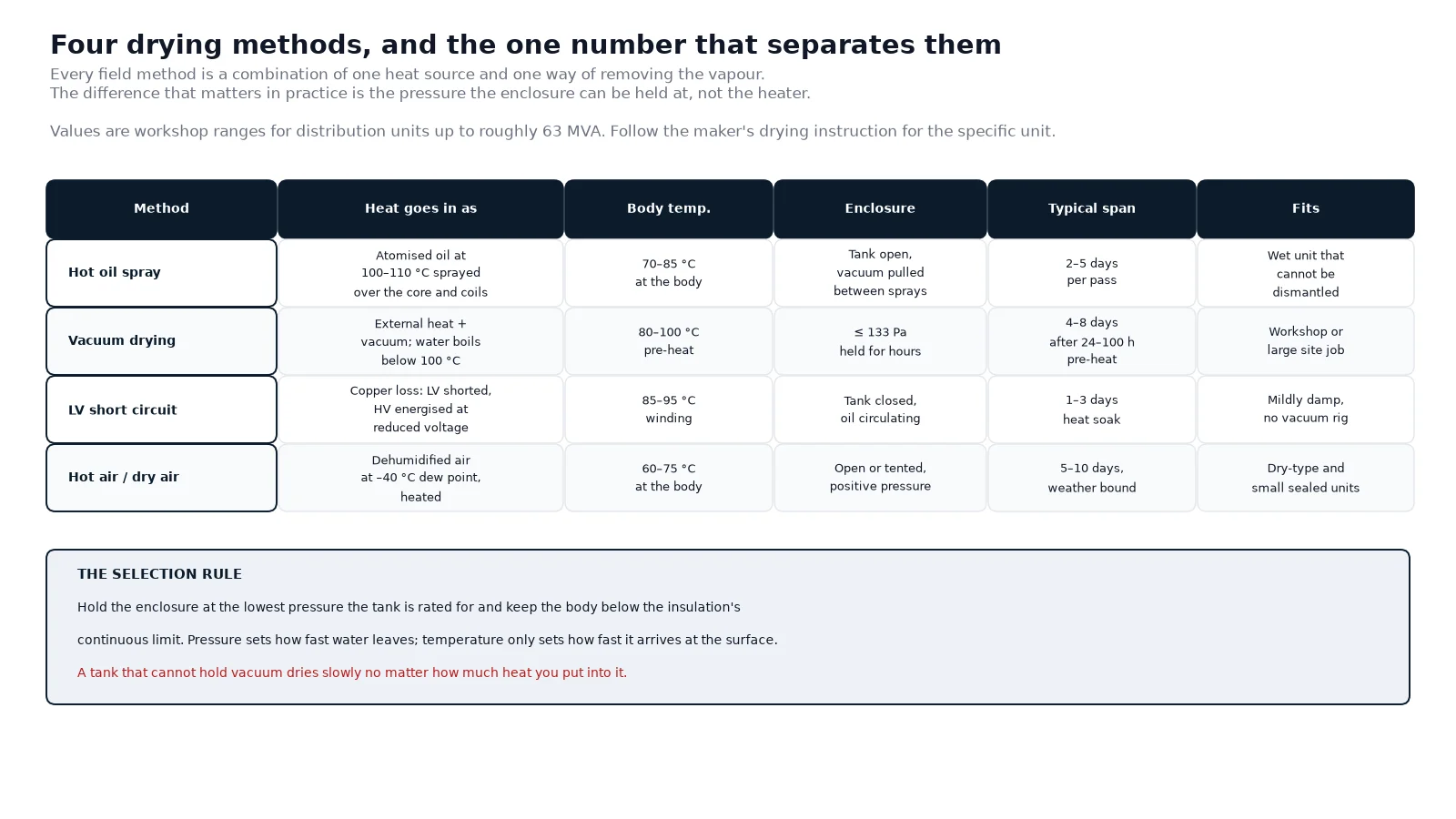
Read the table by column, not by row. The heat source tells you what equipment you need; the enclosure pressure tells you how fast the job will go; the body temperature tells you how much insulation life the job will cost. A method that scores well on the first two and badly on the third is not a bargain.
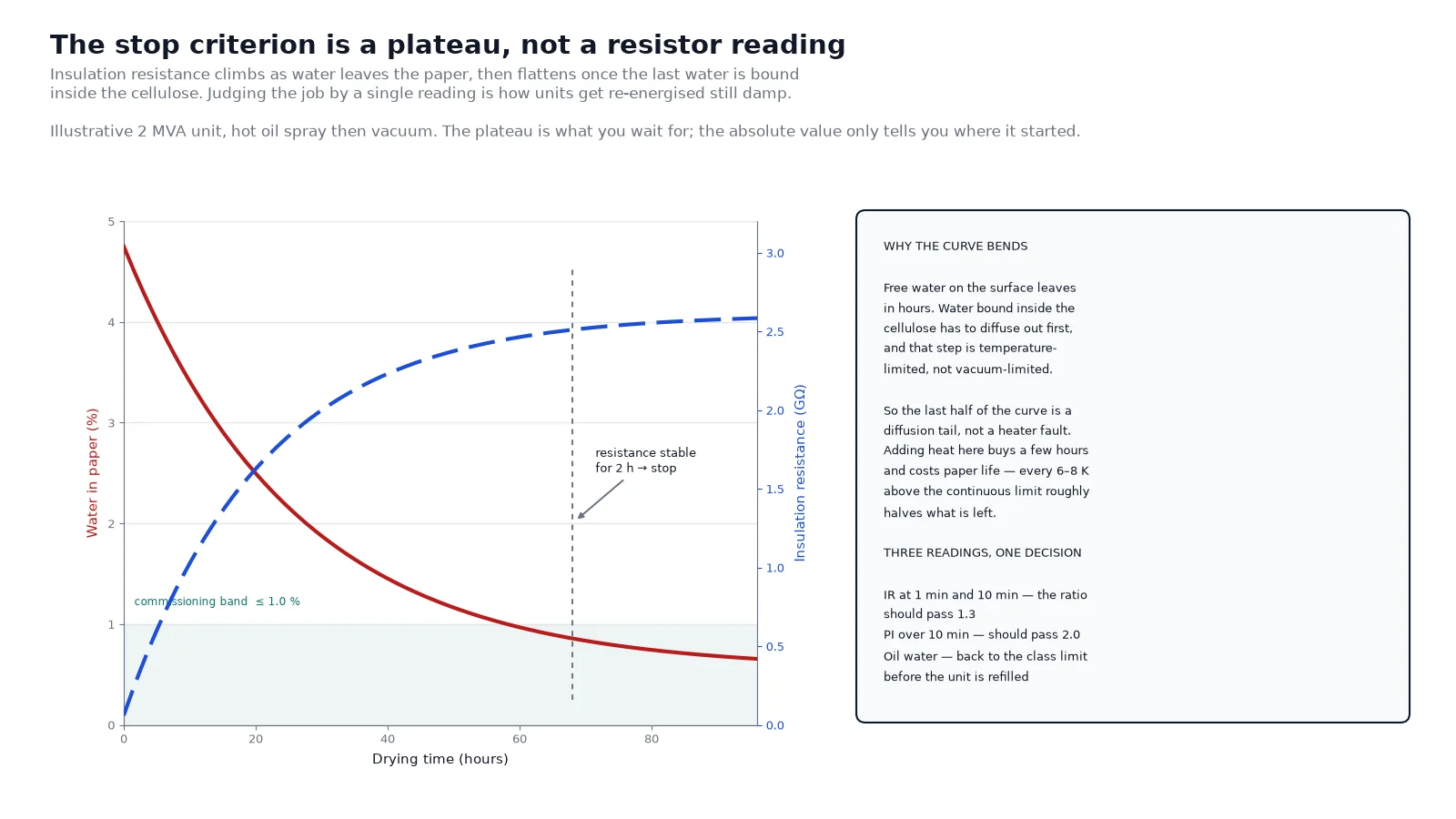
Every drying job ends with the same argument: is it done, or have we just run out of patience? The defensible answer is a plateau, not a threshold.
Nothing in that list is a single measurement. A unit that passes on resistance but keeps climbing in dissipation factor is a unit with contamination, not moisture, and another week of heat will not change it. The oil-immersed maintenance schedule sets out which of these readings belong in the routine record so that the next drying decision has a baseline to compare against.
Drying removes water. It does not reverse the chemistry that the water has already caused. Three limits are worth stating plainly before anyone commits a week of outage to the job:
If a unit needs drying, the useful information for a supplier or a service crew is short: the kVA and voltage class, the winding material and insulation class, the last set of readings with their temperatures and the meter used, whether the tank is rated for full vacuum, and how long the outage window actually is. With those five items a drying method can be chosen in a conversation instead of a site visit.
If the decision is instead to replace the unit, the same readings are what a manufacturer needs to specify a replacement that will not repeat the problem — and it is worth asking what the tank’s leak test and moisture acceptance limits are before the order is placed, rather than after the unit arrives.
For a distribution unit, hot oil spray runs two to five days per pass and vacuum drying four to eight days after a pre-heat of one to four days. Low-voltage short-circuit drying is typically one to three days of heat soak. Dry air is the slowest at five to ten days and is limited by weather. Large power transformers run longer, because pre-heat alone can take a hundred hours when the insulation is thick.
Only in the limited sense of drying the oil. Online oil treatment with a vacuum purifier at 60–70 °C removes water from the oil and lets the paper release some of its own water into the oil over time. It is a holding action for mildly wet units, not a substitute for drying the body.
There is no universal number, because resistance scales with size and temperature and depends on the meter. What matters is a value that has stopped rising and is comparable with the factory record after temperature correction, together with an absorption ratio above 1.3 and a polarisation index above 2.0.
Not if the body temperature stays below the insulation class limit. Drying does damage insulation when the temperature is pushed to shorten a job, or when the unit is cycled hot and cold repeatedly. The ageing is cumulative and cannot be undone.
Vacuum drying is faster and more thorough on thick insulation, but it requires a tank and a pump set rated for the duty. Hot oil spray reaches the same end point more slowly with equipment that fits in a van. The right choice is usually the one the site can support for the whole duration without interruption.
Look at the oil and the breather. Free water or a rising water content with a healthy silica gel points to an oil-side or seal problem; a wet breather charge, a blocked breather or a failed conservator bladder points to breathing wet air. Fix that path before drying, or the unit will be wet again before the next oil test.