SCB10 vs SCB13 vs SCB14 vs SCB18: Which Cast Resin Grade?
Published: Author: Lisa
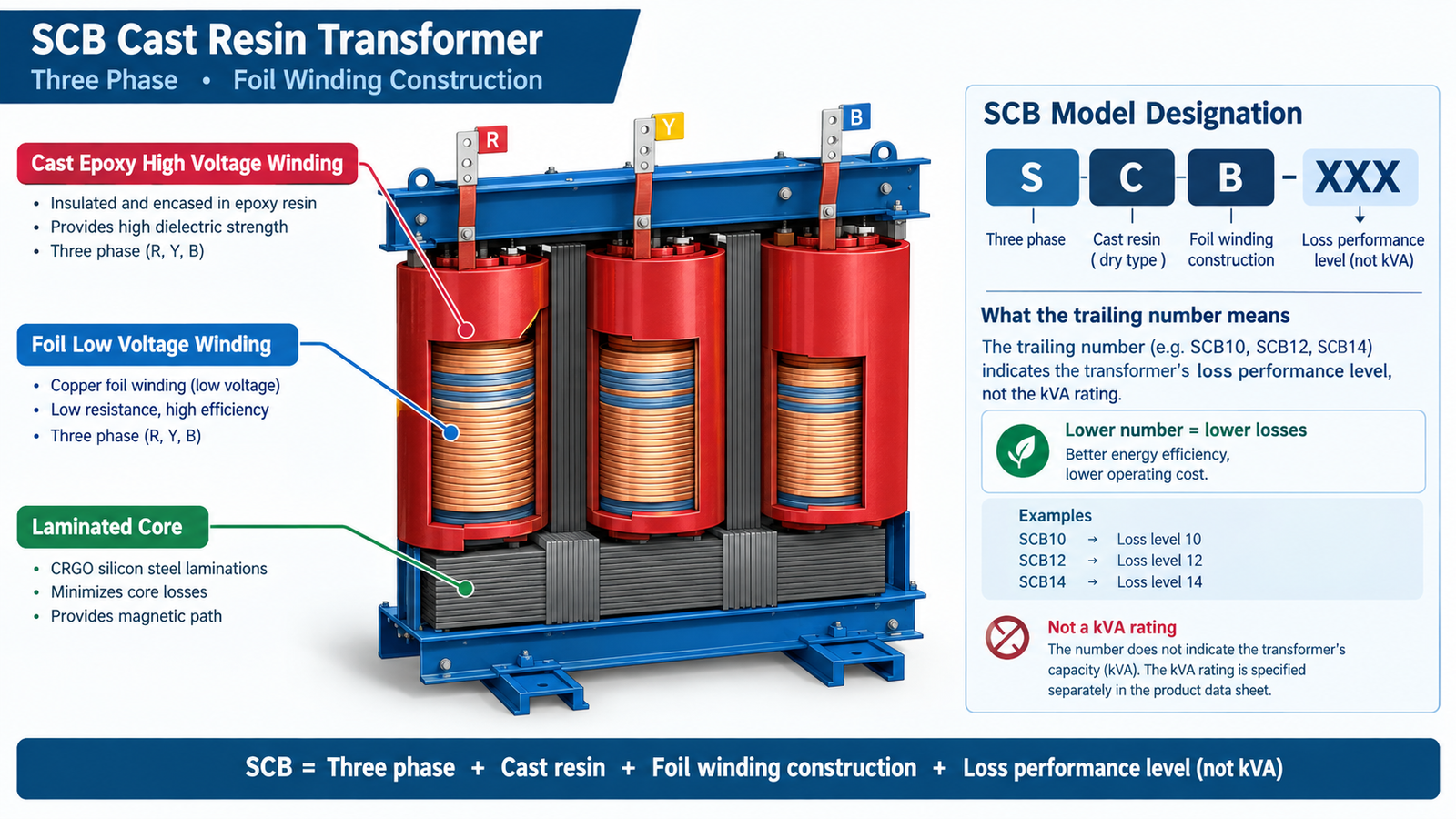
If you are comparing an SCB13 transformer against SCB10, SCB14, or SCB18 quotes, the first thing to fix in your head is what the number means. It is not a kVA rating, not a voltage class, and not a year. It is a loss code from the manufacturer’s design series: the higher the number, the lower the no-load and load losses for the same rating. Everything else — core grade, winding dimensions, noise, weight, and price — follows from that one choice.
The short answer: SCB13 is the volume workhorse that satisfies most energy codes at a sensible price. SCB18 is the low-loss grade you specify when the transformer runs near full load for most of the year or when a green building rating demands it. SCB10 is the older, higher-loss design that survives mainly in price-driven tenders and replacement work. SCB14 sits between 13 and 18 as an intermediate grade that not every factory offers. The rest of this guide is how to verify that claim instead of trusting the label.
Decoding SCB: the letters before the number
SCB is a Chinese design designation used across Asia and increasingly in export tenders. Each letter carries construction information, and getting them right tells you what you are actually buying.
S — three-phase. A single-phase unit is written with D instead.
C — cast resin (epoxy cast) insulation, the moulded solid-insulation type used indoors.
B — foil winding, normally copper or aluminium foil for the low-voltage winding.
So SCB13 means a three-phase, cast-resin, foil-wound transformer in the loss class 13. Compare that with SGB, where the G indicates an open, ventilated dry-type design rather than cast resin, and with S11 or S20, where the absence of a C means an oil-immersed unit. The construction differences behind those letters are covered in the cast resin dry-type transformer overview.
One practical warning: SCB is a Chinese convention. If your project is specified in IEC or IEEE language, the same physical transformer may appear as “1,000 kVA, 10 kV/400 V, Dyn11, uk 6%, cast resin, AN, IP20, Class F”. Expect to translate between the two systems during bid clarification, and never accept a model number as a substitute for a datasheet.
The four grades compared
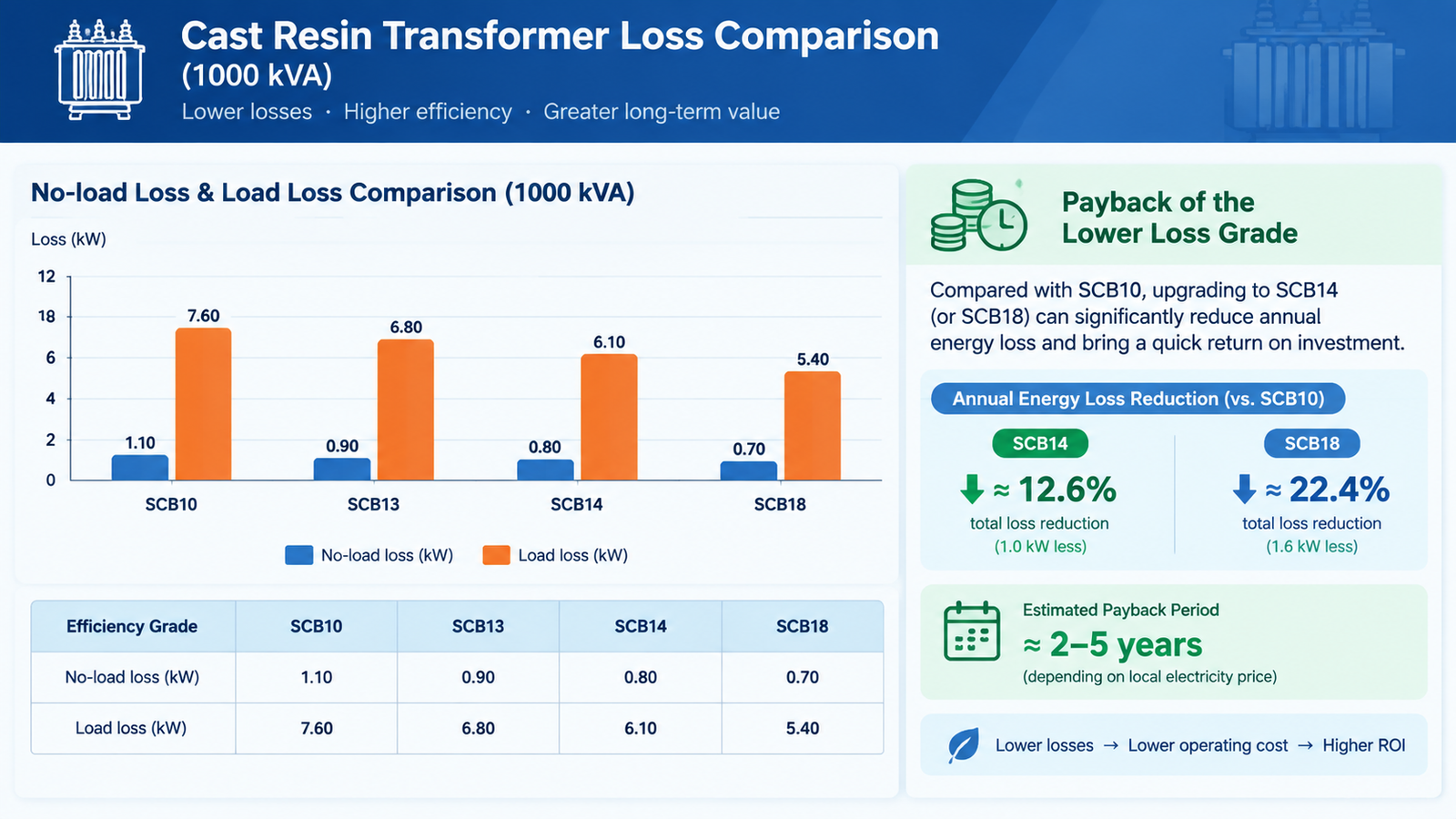
The table below uses indicative values for a 1,000 kVA, 10 kV/0.4 kV, Dyn11 cast resin unit. Published figures vary by factory and core grade, so use this to understand the shape of the difference and then confirm the actual numbers on the datasheet you are asked to approve.
Grade
No-load loss P0 (W, indicative)
Load loss Pk (W, indicative)
Efficiency at 100% load
Typical market position
SCB10
1,750–1,850
9,000–9,500
≈98.9%
Legacy design, price-driven tenders
SCB13
1,350–1,450
8,100–8,400
≈99.0%
Volume grade, meets most codes
SCB14
1,250–1,350
7,700–8,100
≈99.1%
Intermediate, factory-dependent
SCB18
1,050–1,150
7,300–7,700
≈99.2%
Lowest loss, premium price
Read the table as a range, not a specification. A 100 W difference in no-load loss between two factories quoting “SCB13” is normal and reflects core steel grade and flux density choice, not cheating. What is not normal is a quote that claims SCB18 losses while pricing like SCB10 — that usually means the model number is being used as a marketing label.
Where SCB14 actually fits
SCB14 is not a universally standardised step the way SCB13 and SCB18 are in the Chinese catalogue. Some factories offer it as a genuine intermediate grade with a better core grade than SCB13; others list an SCB14 that measures almost identically to their SCB13. The designation is a manufacturer’s internal series, so the only defensible way to compare an SCB14 offer is to demand P0 and Pk at the quoted rating and compare watts, not numbers.
That single habit resolves most grade arguments in a tender: put every offer on one page as kVA, P0, Pk, uk%, and price. The grade name becomes a description; the watts become the decision.
Energy codes decide the floor, not the ceiling
Three regulatory frameworks appear in most export enquiries, and they do not simply map onto SCB numbers.
China, GB 20052-2020 — dry-type distribution transformers are graded 1, 2, or 3 by loss level. Grade 3 is the minimum for new equipment in scope; many public and infrastructure projects require grade 2 or better. A well-known practical mapping puts SCB18 near grade 1, SCB13/SCB14 near grade 2, and SCB10/SCB11 at grade 3, but the mapping is commercial shorthand — compliance is declared per model, not per family.
United States, DOE 10 CFR 431 — the 2016 levels remain the operative baseline, with the 2024 revision taking effect for compliance from 23 April 2029. The US test points differ from IEC practice, and low-voltage dry-type efficiency is assessed at 35 percent load rather than at full load.
Europe, EU 548/2014 — Tier 2 limits apply to most dry-type units placed on the market, with losses declared at 50 percent load for medium-voltage units.
Because the assessment load points differ — 35 percent, 50 percent, or 100 percent — you cannot compare a US efficiency figure with a Chinese one directly. The underlying loss values are comparable; the headline percentage is not. This is one of the traps explained in the efficiency class and loss evaluation guide.
The only honest comparison is capitalised loss
A grade premium is not a cost, it is an investment with a measurable return. The standard method is total cost of ownership with losses capitalised, and it needs only three inputs: your electricity price, the discount rate, and the load profile.
At an 8 percent discount rate, 25 years, and USD 0.12 per kWh, the capitalisation factor for no-load loss is about USD 11.22 per watt. For load loss, multiply by the square of the average load factor. The worked example below compares SCB10 with SCB18 on a 1,000 kVA unit at 50 percent average load.
Item
SCB10
SCB18
Difference
No-load loss P0
1,800 W
1,100 W
−700 W
Load loss Pk
9,250 W
7,500 W
−1,750 W
Capitalised P0 (USD 11.22/W)
20,196
12,342
−7,854
Capitalised Pk at 50% load (USD 2.81/W)
25,993
21,075
−4,918
Lifetime loss cost
46,189
33,417
−12,772
That is roughly USD 12,800 of lifetime saving for stepping two grades up on a single 1,000 kVA unit. Whether it is worth it depends entirely on the price gap. If the SCB18 premium is USD 6,000, the payback is obvious. If it is USD 20,000, it is not — unless the load factor is higher, in which case the load-loss term grows and the case improves.
Run the same calculation at 80 percent load and the load-loss difference alone becomes worth about USD 12,600 instead of USD 4,900. That is why the load profile matters more than the grade name: a data center transformer at 70–80 percent average load justifies a much lower loss grade than a seasonal commercial building at 30 percent.
What else changes when you step up a grade
The losses are the headline, but four other things change with them, and they affect installation cost.
Physical size and weight. A lower-loss design needs more core cross-section and often a larger winding window. Expect SCB18 to be taller and heavier than SCB10 at the same rating, which changes plinth dimensions, door widths, and lifting arrangements.
Noise. Lower flux density usually reduces sound pressure, but a larger core can also radiate more. Ask for the guaranteed sound level in dB(A) at 1 m and compare it, rather than assuming that a better grade is quieter.
Temperature rise. Lower losses mean lower temperature rise for the same cooling class, which is why high-grade units often carry a longer overload margin. Verify the declared rise and the insulation class together.
Price and lead time. Better core steel is a longer-lead material. On a fast project, the grade with the shortest confirmed core supply can beat the theoretically cheaper one.
Load factor justifies a step up if the price gap is small
Export tender with a fixed loss table
Whatever meets the declared limits
Compliance is binary; extra margin only adds cost
Replacement of an SCB9/SCB10 in place
SCB13
Same footprint class, immediate loss reduction
Ordering checklist
Rating and voltage ratio — kVA, HV/LV, tap range, frequency.
P0 and Pk in watts, at a stated reference temperature, plus the tolerance you will test against.
Impedance uk% with the tolerance, because it drives downstream breaker ratings.
Temperature rise and insulation class, stated together (for example 100 K rise on a Class F system).
Enclosure and IP rating, plus the resulting cooling derating if the unit is enclosed.
Sound level in dB(A) at 1 m, guaranteed.
Dimensions and mass, so the civil and lifting plans are not a surprise.
Standards and marks — IEC 60076-11, GB 1094.11, UL 1561 for units at or below 600 V, UL 1562 above 600 V.
The difference between UL 1561 and UL 1562 is worth repeating because it is misquoted constantly: a 480 V dry-type transformer is a UL 1561 product. Only units above 600 V fall under UL 1562.
Common mistakes
Treating the number as a rating. SCB13-1000/10 is a 1,000 kVA unit in loss class 13, not a 13 kVA unit and not a 13 kV design.
Comparing efficiency percentages across standards. A 99.1 percent figure at 35 percent load is not comparable with 99.1 percent at 100 percent load.
Buying the grade without the load profile. The lowest-loss unit on a lightly loaded transformer can be the worst financial decision in the package.
Assuming SCB14 is always between 13 and 18. It is a manufacturer series; the watts decide.
Ignoring the space penalty. A higher grade is bigger, and a retrofit into an existing enclosure may not fit.
Conclusion
SCB10, SCB13, SCB14, and SCB18 are four points on one axis: how much loss you are willing to pay for up front to avoid paying for it every hour for 25 years. Put the offers on one page as watts, convert the difference into capitalised cost with your own electricity price and load factor, and the choice stops being a matter of taste. For most commercial and distribution work, SCB13 is the right default; for high-utilisation loads, the arithmetic pays for SCB18 quickly.
If you have a load profile and a target price, the Kampa engineering team can run the loss capitalisation against several grades and send the comparison with actual quoted losses. For units in the 10 kV class, the 10 kV dry-type transformer selection guide covers the surrounding specification decisions.
FAQ
Is a higher SCB number always better?
It always means lower losses, but “better” depends on price and load. A high grade on a lightly loaded transformer can have a payback longer than the equipment life. Compare capitalised loss, not the number.
What does SCB13 mean in kVA?
Nothing. The kVA is the figure after the hyphen, as in SCB13-1000/10, which is 1,000 kVA with a 10 kV high-voltage winding. The 13 is the loss class.
Is SCB13 the same as a grade 2 energy efficiency transformer?
In common Chinese market usage, SCB13 is often quoted as meeting grade 2 under GB 20052-2020. Compliance is declared per model on the nameplate, so confirm the grade in writing rather than inferring it from the family name.
Can I replace an SCB10 with an SCB18 in the same space?
Sometimes, but not reliably. Low-loss designs are usually larger and heavier at the same rating. Check the outline drawing and mass before committing to a like-for-like swap in an existing enclosure.
Do cast resin grades affect short-circuit withstand?
Not directly. Short-circuit withstand depends on winding design, bracing, and the declared impedance. A change of loss grade changes the design, so the short-circuit certificate must cover the specific model you order.