Copper or aluminium is one of the few genuinely open choices in a transformer specification, and it is almost always decided in the wrong place — on the invoice, by whoever quotes the lower number. Both materials produce transformers that meet the same standards, carry the same guarantee and pass the same routine tests. What changes is the physical size of the machine, its weight, the quality of the joints, the residual value at end of life, and — if the design is not held to a fixed loss target — the energy bill for the next twenty-five years.
This article separates the engineering from the folklore. It sets out what the physical difference actually costs in copper, iron and freight, gives a worked total cost of ownership example with the assumptions left visible, and lists the cases where the answer is genuinely one-sided. For the surrounding selection context, see the dry-type and oil-immersed ranges.
The Physical Difference That Drives Everything
| Property |
Copper (ETP) |
Aluminium (EC grade) |
| Resistivity at 20 °C |
1.72 × 10⁻⁸ Ω·m |
2.82 × 10⁻⁸ Ω·m |
| Relative conductivity |
100% IACS |
61% IACS |
| Density |
8.96 g/cm³ |
2.70 g/cm³ |
| Tensile strength, annealed |
~220 MPa |
~70–100 MPa |
| Thermal conductivity |
401 W/m·K |
237 W/m·K |
| Coefficient of thermal expansion |
16.5 × 10⁻⁶ /K |
23.1 × 10⁻⁶ /K |
| Melting point |
1085 °C |
660 °C |
| Scrap value at end of life |
High, well-established market |
Lower, thinner market |
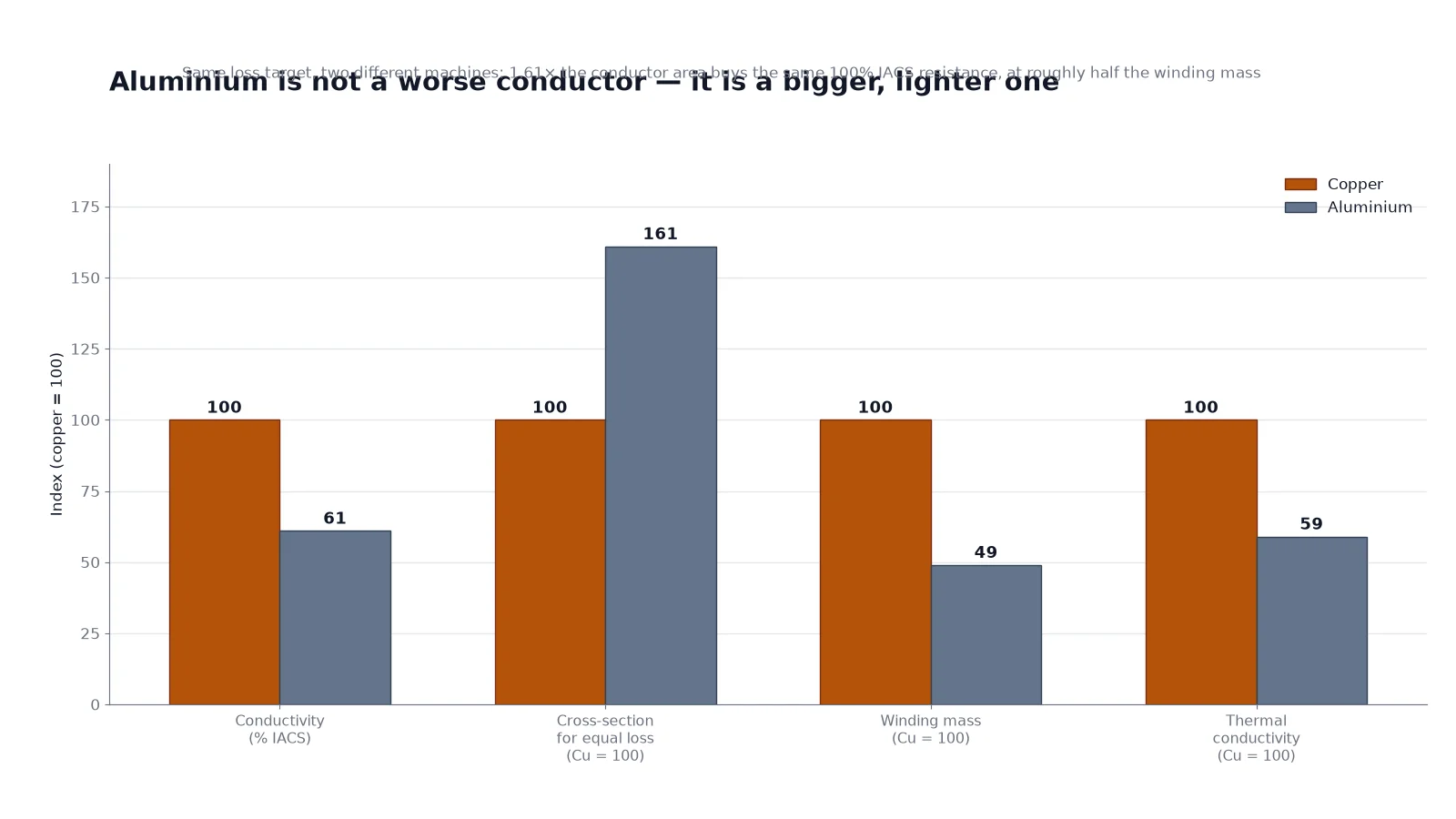
Two numbers control the rest. Aluminium conducts at 61% of copper’s rate, so an aluminium conductor needs roughly 1.6 times the cross-sectional area to carry the same current at the same resistance. But aluminium weighs only 30% as much per unit volume, so despite the larger conductor, the finished aluminium winding still comes out at roughly half the weight of the copper equivalent.
The Loss Misconception: Aluminium Is Bigger, Not Worse
The most persistent error in tender discussions is that aluminium windings mean a less efficient transformer. That is only true when a copper design is simply re-wound in aluminium without changing anything else — in which case the resistance rises by a factor of 1.61 and the load loss rises with it.
No competent manufacturer works that way. Load loss is I²R, so if the conductor cross-section is increased by the resistivity ratio, the resistance returns to the copper value and the load loss matches it exactly. Manufacturers design to a loss target — a customer limit, an EU Ecodesign tier, or a national efficiency grade — and select conductor dimensions to hit it. Both materials can reach any target that is physically achievable in the frame.
What changes is the size of the machine, not its efficiency. That distinction is the whole argument, and it is why the specification must state losses in watts rather than saying “copper windings” and assuming the efficiency follows. The mechanics of the loss grades themselves are covered in transformer efficiency classes and loss evaluation.
Where the Extra Conductor Material Goes
An aluminium winding at equal loss needs about 60% more conductor volume. That has knock-on effects across the whole design:
- Winding volume rises by roughly 60%, and the winding pack becomes deeper.
- Core window must grow to accept the larger winding, which increases the mean length of the magnetic path and therefore the core weight.
- Tank or enclosure grows, typically 10–15% in overall dimensions for an oil-immersed unit.
- Oil volume increases with the tank, which raises fluid cost, transport weight and the consequences of a leak.
- No-load loss tends to creep up because the core is larger, unless the core is redesigned to compensate.
The net position is usually a transformer that is 10–20% cheaper on material but 10–15% larger, and — critically — lighter overall. Buyers who only look at the tank dimensions conclude aluminium is inefficient. Buyers who look at the crane load and the freight invoice conclude the opposite.
Worked Example: 1,000 kVA, 10 kV / 0.4 kV
Take a standard Dyn11 distribution transformer at 1,000 kVA with a loss limit that both designs must meet. The design data below are representative of the class rather than a quotation, but the arithmetic is the arithmetic.
| Item |
Copper winding |
Aluminium winding, loss-matched |
| Conductor mass |
~640 kg |
~330 kg |
| No-load loss P0 |
1.70 kW |
1.80 kW |
| Load loss Pk at 75 °C |
14.0 kW |
14.4 kW |
| Total mass |
~3,050 kg |
~2,720 kg |
| Oil quantity |
~640 kg |
~700 kg |
| Indicative factory price |
Baseline |
8–18% lower |
Now capitalise the losses. Using the standard loss-evaluation formula, the present value of one watt of no-load loss over 25 years at 8% discount and USD 0.12/kWh is about USD 11.22; a watt of load loss is that figure multiplied by the square of the load factor. At a 60% load factor the load-loss coefficient is about USD 4.04/W.
| Cost element |
Copper |
Aluminium |
| Capitalised no-load loss (P0 × 11.22) |
USD 19,074 |
USD 20,196 |
| Capitalised load loss (Pk × 4.04) |
USD 56,560 |
USD 58,176 |
| Capitalised losses, total |
USD 75,634 |
USD 78,372 |
| Price delta at 12% cheaper |
— |
−USD 1,900 (approx.) |
| 25-year position |
Reference |
USD 800–1,300 worse |
The conclusion is uncomfortable for both camps. Aluminium does not automatically lose on lifecycle cost, and it does not automatically win either. The deciding variable is load factor, because it scales the load-loss penalty quadratically.
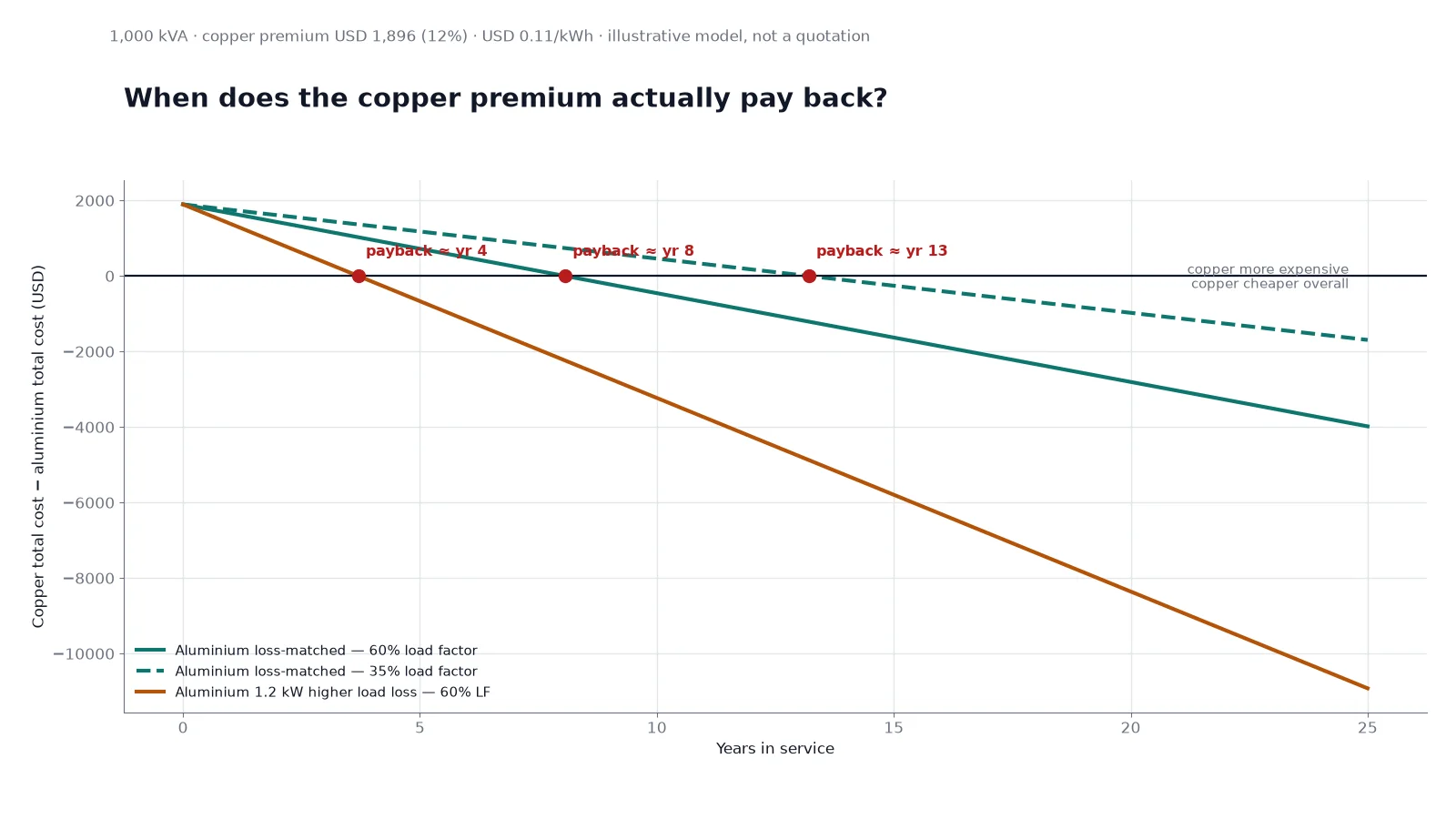
Two answers follow, and both are correct. Where the aluminium unit is designed to the same loss target, the copper premium of roughly USD 1,900 pays back around year 8 at a 60% load factor and around year 13 at 35%. Where the aluminium bid carries a 1.2 kW load-loss penalty because the conductor was not fully upsized, payback shortens to about year 4 at the same 60% load factor. That is why two honest quotations for the same 1,000 kVA transformer can produce payback figures five years apart — the material is not the variable, the loss declaration is. A distribution transformer on a lightly loaded rural feeder is a fundamentally different economic object from a unit carrying a data hall at 70% around the clock. The price guide sets out the raw cost bands if you want to rebuild this model with your own figures.
Short-Circuit Strength: The Real Engineering Difference
This is where the material choice has consequences that a spreadsheet barely captures. Through-fault electromagnetic forces scale with the square of the current, and they act to deform the winding axially and radially. Copper’s tensile strength is two to three times that of annealed aluminium, so a copper winding resists those forces with more intrinsic margin.
Aluminium is not disqualified. IEC 60076-5 sets the same withstand requirement for both materials, and aluminium-wound transformers meeting it are produced in very large volumes worldwide. What it means is that the mechanical design must compensate — heavier axial clamping, closer winding support, conductor geometry chosen for stiffness as well as conductivity. That work is invisible on a datasheet and it is exactly where a cheap aluminium bid differs from a properly engineered one.
Practical guidance: where the prospective fault current is high relative to the transformer rating, or where the unit will see frequent through-faults from recloser operations, copper buys margin that is difficult to verify after the fact. Ask for the short-circuit test report, not the short-circuit claim. Our note on impedance, short-circuit current and voltage drop explains how to compute the forces for your own system.
Connections and Terminations: Where Aluminium Actually Fails
Almost every serious aluminium field failure traces back to a joint, not to the winding. Three mechanisms are responsible.
The oxide film. Aluminium forms a hard, electrically insulating oxide layer within minutes of exposure to air. A joint must be made in a way that breaks through that layer and prevents it reforming — crimping with the correct die, friction welding, ultrasonic welding, or a plated interface. A bolted joint made without preparation has a contact resistance that is both high and unstable.
Galvanic and thermal mismatch. Direct aluminium-to-copper contact creates a corrosion cell, and the two metals expand differently under load cycling. The joint loosens, resistance rises, the joint runs hotter, and the cycle accelerates. Bimetallic transition plates or plated terminations break the cell and restore stability.
Creep. Aluminium deforms slowly under sustained clamping pressure, so a joint that was correctly torqued at commissioning can lose preload over years. This is why aluminium terminations carry a re-torque interval in the maintenance manual and copper terminations usually do not.
The historical caution is genuine: several building fires in the United States in the 1970s were traced to aluminium branch-circuit connections made without the correct hardware. Modern transformer practice — bimetallic lugs, plated pads, controlled-torque bolts and a defined re-torque interval — resolves all three mechanisms. But it means the choice of winding material propagates into the installation instructions, the cable lugs your contractor buys, and the maintenance schedule. A buyer who specifies aluminium to save 12% and then installs it with copper-rated lugs has bought the worst of both.
Thermal Behaviour and Insulation Life
Copper conducts heat away from the conductor about 70% better than aluminium. In a well-designed winding this barely changes the hot-spot temperature, because the heat path is dominated by the insulation and the cooling ducts rather than by the conductor itself. In a marginal design it matters, because the aluminium winding runs a few degrees hotter for the same loss, and insulation ageing is exponential in temperature — the classic rule of thumb is that life halves for every 8 K of additional hot-spot rise in class A systems, and roughly every 6–10 K in modern class F and H systems.
The larger thermal expansion coefficient of aluminium has a second-order effect: 23.1 versus 16.5 × 10⁻⁶/K means 40% more movement per degree. In a cast resin winding this is absorbed by the casting and the compliant end termination; in an oil-immersed winding it is absorbed by the clamping structure. In both cases it is a design detail that a competent manufacturer handles and a careless one ignores.
Where Aluminium Wins Outright
- Pole-mounted and platform transformers. The weight saving is a direct operational advantage for line crews and for pole loading calculations.
- Roof-top and podium-level installations. Structural steel and crane capacity are priced per kilogram, and the saving often exceeds the transformer price gap.
- Retrofit into an existing room. A lighter unit can sometimes pass through a doorway and be landed on an existing floor where copper cannot.
- Long-haul export freight. Sea freight is charged on volume and weight; a 10% weight reduction on a multi-unit order is real money.
- Lightly loaded distribution duty. Low load factor removes the lifecycle argument against aluminium almost entirely.
- Budget-constrained rural electrification programmes. Where the alternative is no transformer, aluminium is the right answer and the industry has standardised on it for decades.
Where Copper Wins Outright
- High fault level or frequent through-faults. Mechanical margin matters and cannot be retrofitted.
- Space-constrained rooms. The smaller copper winding can be the difference between fitting and not fitting.
- High ambient temperature. The extra thermal conductivity and the lower expansion both help where the ambient sits above 45 °C.
- Harmonic-rich duty. Additional losses concentrate in the winding; the material with more thermal headroom wins.
- Mobile, portable and rental units. Repeated transport and re-termination punish aluminium joints.
- Assets with a resale or relocation value. Copper’s scrap and resale value is a genuine balance-sheet item on a 30-tonne machine.
How to Stop a Bid Being Switched Under You
Mixed-material substitution is the most common commercial risk in this decision. A bid is evaluated on a copper design and delivered with an aluminium winding, or vice versa, because the purchase order never named the material. Four clauses close that gap:
- State the winding material explicitly in the technical specification, and state that substitution requires written approval.
- State P0 and Pk in watts at the reference temperature, with the tolerance and the test standard. The loss figure is the real contract, not the material name.
- Require the conductor material to appear on the rating plate and in the test certificate, and require a mill certificate for the conductor.
- Require the termination hardware to be listed in the delivery scope, matched to the winding material.
Add the conductor mass to the technical data sheet — an aluminium unit that claims copper-class losses with a copper-class conductor mass is either misdeclared or not loss-matched. The technical data sheet template lists the fields that expose this. Our comparison of dry-type insulation systems covers the parallel decision on how the winding is insulated, which interacts with the material choice in cast resin designs.
Frequently Asked Questions
Is an aluminium-wound transformer less efficient than a copper one?
Only if it was designed by re-winding a copper design without changing the conductor size. Designed to the same loss target, an aluminium unit achieves the same P0 and Pk and therefore the same efficiency. It achieves them with a larger, lighter, cheaper machine.
How much cheaper is aluminium, really?
At equal loss target, typically 8–18% on the factory price for distribution ratings. Quotes showing 30–50% savings usually compare an aluminium unit against a copper unit built to a tighter loss limit, or against a copper unit at a different efficiency grade. Compare at equal P0 and Pk and the gap narrows sharply.
Can aluminium windings meet EU Ecodesign Tier 2?
Yes. The tier limits are loss limits, and aluminium designs meet them by using more conductor and a redesigned core. The cost of compliance is material, not feasibility.
What is the payback period on the copper premium?
At a 60% load factor and USD 0.10–0.12/kWh, typically 3–7 years. Below about 40% load factor the payback stretches beyond a decade and may never arrive. Site-specific load profile matters more than the industry average, which is why published payback figures vary so widely.
Do aluminium transformers need more maintenance?
They need different maintenance: a defined re-torque interval on the terminations, and inspection of bimetallic joints. The core, the oil and the cooling system need the same attention as any other unit. The difference is a line in the maintenance schedule, not a change of maintenance regime.
Is copper better for harmonic loads?
It has more thermal margin at the hot spot and lower expansion, both of which help under K-factor duty. But a well-designed aluminium unit with a harmonic allowance in the loss calculation is entirely serviceable. Specify the harmonic spectrum and let the designer size for it, rather than relying on the material name.
The Decision in One Paragraph
Ask two questions before choosing. First, what is the load factor and energy price over the next twenty-five years — because that decides whether the loss penalty on aluminium ever gets repaid. Second, what does a kilogram cost at this site — because on a roof, on a pole, on a long sea route or behind a narrow doorway, the lighter unit often wins before the lifecycle model is even opened. If neither question produces a clear answer, copper is the conservative default: it costs more at the door and asks less of everyone afterwards. Whichever way it goes, write the material and the losses into the specification, because that is what prevents the bid you approved from becoming the unit you received.