Two outdoor vacuum breakers, both 12 kV, both pole-mounted, both sold into the same distribution projects. The choice between ZW8-12G and ZW32 is decided by very little of what appears on the data sheet and by a great deal of what appears on the pole. Weight, mounting height, whether the current transformers are inside the tank or bolted to the frame, and whether anyone can reach the manual handle from a ladder are what actually separate these two designs.
Both are legitimate answers to different versions of the same question. This comparison sets out where they differ mechanically and electrically, what each difference costs in installation and maintenance, and the decision matrix we use when a project engineer asks which one to put on a feeder.
Quick answer: same job, different construction philosophy
ZW8-12G is the heavier, more conservative design: a three-phase common tank with bushings on top, current transformers integrated in the tank, a spring mechanism, and a rating range that extends to 1250 A and higher breaking currents. ZW32 is the lighter, more compact design: vacuum interrupters cast into solid insulation poles, a smaller tank, lower weight, ratings typically centred on 630 A, and a form factor intended for direct pole mounting with less structural work.
Put simply, ZW8-12G is what you specify when the fault level is high, the load is heavy, and metering has to be integral. ZW32 is what you specify when the pole is standard, the load is a distribution branch, and the installation crew is working from a bucket truck.
Construction differences that matter
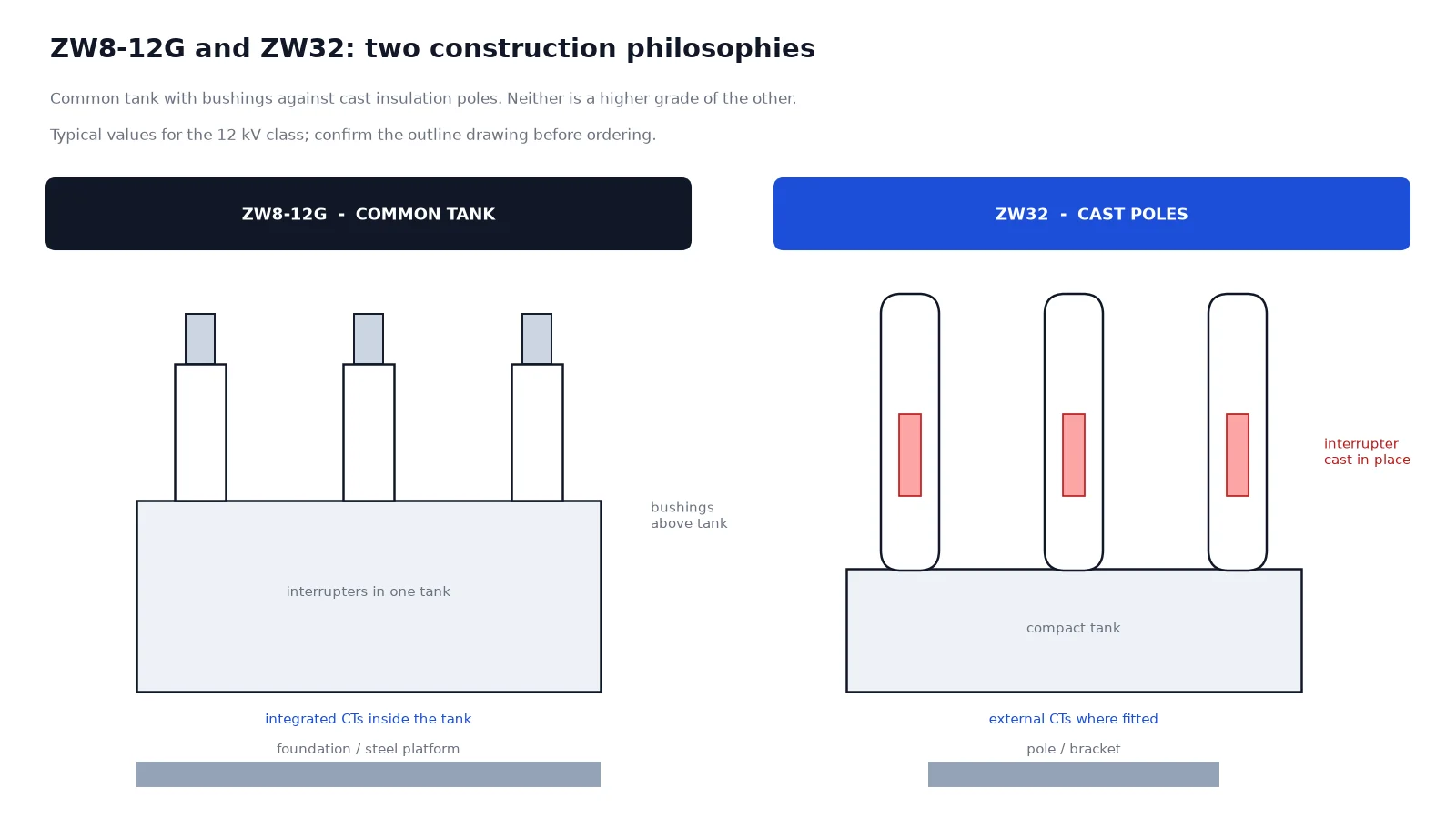
The insulation column. ZW32 casts each vacuum interrupter into an epoxy or silicone-rubber pole. The pole is the insulation, the interrupter housing and the structural element at once, which is why the unit is small and why it has no exposed live parts above the tank. ZW8-12G uses a common tank with separate bushings; the interrupter sits inside the tank in insulating medium, and the bushings carry the connections through the cover. The bushing approach is easier to inspect and easier to replace individually, and the cast-pole approach is much more resistant to pollution and condensation because there is no air gap to track across.
Current transformers. ZW8-12G normally carries two or three current transformers inside the tank, with ratios selectable at ordering and often a second core for metering. ZW32 has variants with integrated CTs and variants without, and the CT provision is a specifying decision rather than a standard feature. If the scheme needs protection-grade CTs with a defined accuracy limit factor, the ZW8-12G arrangement is the simpler specification, because the CTs are part of the breaker rather than an external set that has to be mounted and wired on the pole.
Weight and mounting. The common-tank design is heavier — typically in the range of 200 to 300 kg for a three-phase unit depending on rating, against roughly half that for a compact ZW32. That weight lands on the pole bracket, the pole itself, and the crew. It also affects the mounting height that is achievable and the size of the cross-arm needed. On a standard 11 m or 12 m distribution pole, the heavier unit may require a platform or a two-pole structure, which is a civil and access cost that does not appear on the breaker quotation.
Electrical comparison
| Parameter |
ZW8-12G |
ZW32 |
| Rated voltage |
12 kV |
12 kV, with 24 kV variants in the same family |
| Systems served |
10 kV, 11 kV |
10 kV, 11 kV; 20 kV, 22 kV for the 24 kV variant |
| Rated normal current |
Typically 630 A to 1250 A |
Typically 630 A, up to 1250 A in specific frames |
| Rated short-circuit breaking current |
20 kA to 31.5 kA depending on frame |
20 kA to 25 kA typical |
| Short-time withstand |
20 kA, 4 s common |
20 kA, 4 s common |
| Mechanism |
Spring, motor or manual charged |
Spring or permanent magnet, depending on variant |
| Current transformers |
Integrated, two or three cores |
Variant-dependent; external CTs common on basic units |
| Insulation to earth |
Air clearance plus bushing creepage |
Solid cast pole, minimal air clearance |
| Operating voltage for control |
DC 110 or 220 V, AC 220 V |
DC 110 or 220 V, AC 220 V |
Two lines in that table decide most projects. The breaking current line decides whether the unit can sit at a substation incomer where the fault level is set by the transformer, and the current transformer line decides whether the metering and protection scheme needs a separate CT installation.
On breaking current, the distinction is not a quality difference. A 20 kA breaker is not a worse product than a 31.5 kA breaker; it is a different application. What matters is the actual fault level at the point of installation, which for a feeder branch is often 12.5 to 20 kA and for a busbar near a large transformer can exceed 25 kA. Sizing the breaker to the calculated fault level with the standard margin is the correct procedure — our guide to reading a vacuum circuit breaker nameplate shows which rating fields carry that number and which are often confused with it.
The consequence of weight: mounting, access and clearance
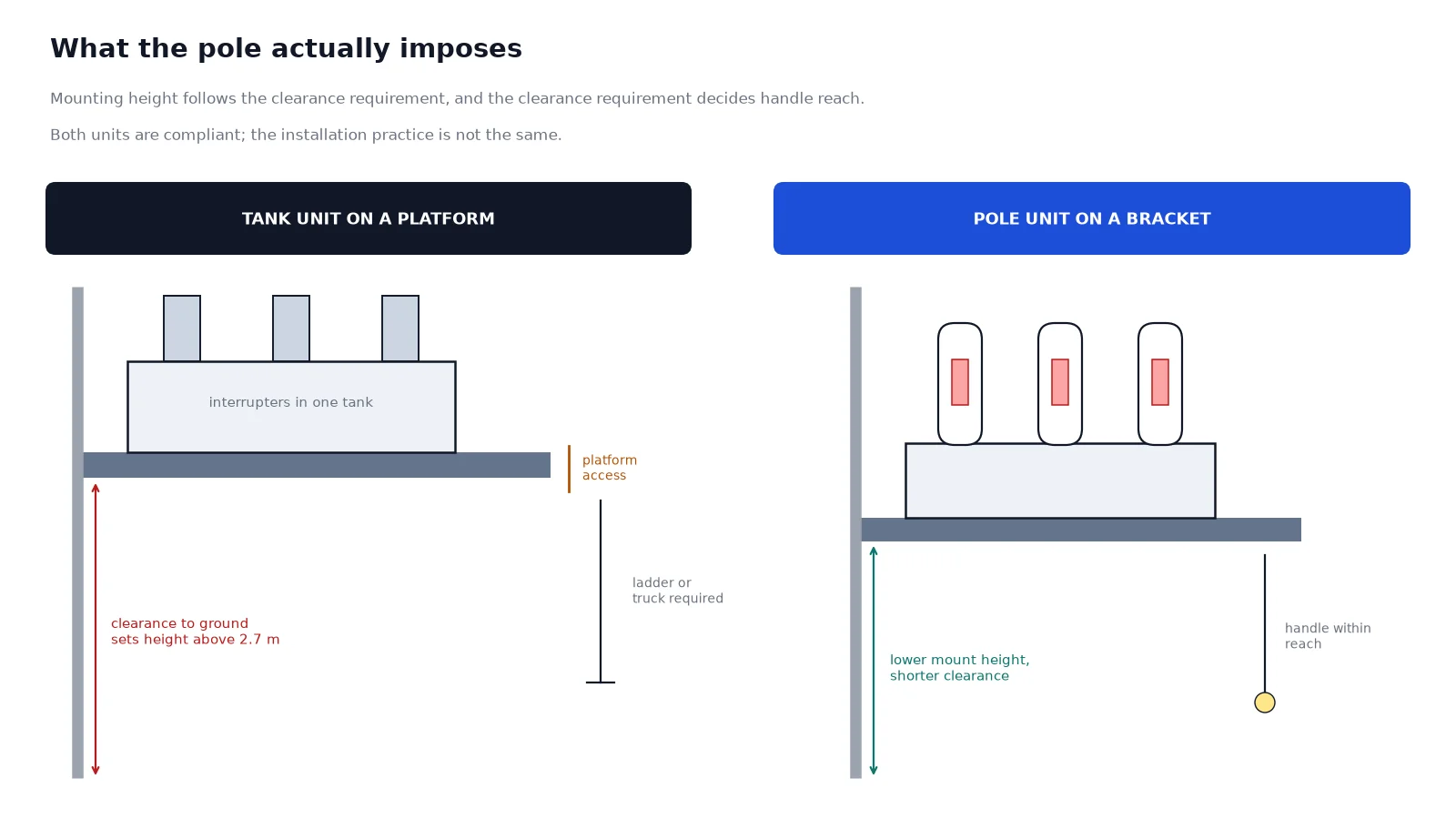
Pole-mounted breakers are installed to a clearance requirement, not to a convenient height. The minimum phase-to-ground clearance for a 12 kV outdoor installation, and the clearance from the operating handle to any live part, set the mounting height. A heavier unit is usually mounted higher because its bushings are taller, and that means the manual operating handle is further from the ground.
This is a maintenance reality rather than a design nicety. If the only way to trip the breaker locally after a control supply failure is a manual handle two and a half metres up, the crew will need a ladder or a bucket truck for a task that should take thirty seconds. The lighter ZW32 with a lower mounting height and a handle at reachable level changes the operating practice on the feeder. Confirm the handle height on the outline drawing before ordering, and check it against how the utility actually operates.
Weight also drives the pole and foundation. A 250 kg breaker on a bracket imposes a bending moment at the pole top, and the pole class has to be right. Where the existing pole is marginal, the lighter unit is the cheaper project even if the breaker itself costs more.
Pollution, humidity and the cast-pole advantage
In coastal and industrial areas the creepage path is the failure mechanism, and the two designs behave differently. A bushing is a creepage path along a surface with air on one side; pollution deposits on that surface, moisture wets it, and the leakage current either tracks or flashes over. A cast pole encapsulates the whole assembly in solid insulation with sheds on the outside, so there is no air gap for the arc to establish and the creepage distance is defined by the shed profile.
The practical difference is not that one design is immune. It is that the failure mode of a polluted bushing is a flashover with visible damage, while the failure mode of a polluted cast pole is surface tracking that often starts at a shed root and can be found only by close inspection. For a site with a pollution severity of heavy or very heavy, either choose a unit with an adequate creepage distance specified against IEC 60815, or accept a shorter cleaning interval.
Which one on which pole
| Application |
Preferred unit |
Reason |
| Feeder sectionalising on a rural 11 kV line |
ZW32 |
Light, direct pole mount, 630 A is the branch rating |
| Substation incomer or transformer bay |
ZW8-12G |
Higher breaking current, integrated CTs for protection |
| Metering point with revenue CTs |
ZW8-12G |
CT cores inside the tank, defined ratios and classes |
| Distribution automation with remote control |
ZW32 |
Compact controller interface, motorised variants, lower weight on the pole |
| Industrial plant overhead distribution |
Either, by fault level |
Fault level near the plant transformer drives the choice |
| Tie point between two feeders |
ZW8-12G |
Higher breaking current for loop conditions |
| Replacement on an existing standard pole |
ZW32 |
Fits existing bracket and pole class without civil work |
Where a load break switch is the better answer
Not every pole-mounted switching point needs fault interruption. If the requirement is to isolate a section for maintenance, or to switch load current but not fault current, a load break switch with a fuse does the job at a fraction of the cost and weight, and the fuse handles the fault. Putting a breaker where a switch was sufficient is a common overspecification in distribution projects, and it doubles the control and battery requirement for no operational benefit.
The dividing question is whether protective tripping is needed. A breaker with a protection relay can trip on overcurrent and reclose; a load break switch cannot. Our guide to the load break switch and fuse combination covers where the combination is the correct and cheaper choice. Where the answer is a breaker, the pole-mounted comparison here applies.
What to include in the enquiry
Seven items: system voltage and the fault level at the point of installation, the load current to be carried, whether current transformers are required and at what ratios and classes, the control supply available on the pole, whether remote control and telemetry are needed, the pole type and its class, and the pollution severity of the site. The last two are the ones buyers leave out and the ones that generate the change orders.
For ratings and outlines, the ZW8-12G outdoor vacuum circuit breaker page carries the heavier frames with integrated CTs, and the ZW32 12 and 24 kV range covers the compact pole-mounted frames including the 24 kV variant for 20 and 22 kV systems. If the project also includes 35 kV feeders, the choice between platform and pole frames at that level is in our ZW7-40.5 and ZW32-40.5 comparison, the three-frame overview is our VS1, ZW32 and ZW7 comparison, and the full vacuum circuit breaker range lists every outdoor frame with its rating class.
FAQ
Is ZW32 a replacement for ZW8-12G?
Only in the lower part of the rating range. ZW32 covers the 630 A distribution branch duty well and is lighter and easier to install. It does not replace a 1250 A, 31.5 kA unit with integrated metering CTs at a substation incomer. They overlap in the middle of the range and diverge at both ends.
Can ZW32 be supplied with current transformers?
Yes, in some variants, and the ratios and classes have to be specified at ordering rather than added later. If the project needs protection-grade CTs with a defined accuracy limit factor, confirm the core specification on the drawing. Where CTs are external, allow for the mounting and secondary wiring on the pole.
Which unit is better in a coastal environment?
The cast-pole design has an advantage because the insulation is solid and there is no air gap to track across. That advantage is only realised if the shed profile gives an adequate creepage distance for the pollution level. Compare the specified creepage distance against IEC 60815 for the site severity rather than relying on the construction type alone.
How much does the mounting height affect the choice?
It affects operating practice more than electrical performance. A heavier unit with taller bushings is usually mounted higher, which puts the manual handle out of reach. If local operation after a control failure matters, check the handle height on the outline drawing and compare it with how the crew will actually access the pole.
What breaking current should I specify for a feeder branch?
The calculated fault level at the installation point with the standard margin, not the highest rating available. A feeder branch fed through a small transformer often has a fault level well under 20 kA, and specifying 31.5 kA buys nothing except cost and weight. Where the breaker sits close to a large transformer, the number goes up quickly and the higher frame is justified.
Can either unit be operated remotely?
Both can, with a motorised mechanism and a controller, but the auxiliary supply requirement is different in each case and the pole has to carry it. A remote-controlled installation needs a battery or a capacitive supply, a controller enclosure and a communication path, and those items weigh and cost more than the difference between the two breakers.
Send the fault level, load current, CT requirement and pole class, and we will return one frame rather than two options to compare.