Every oil-immersed transformer has to answer one question before any other design choice is made: what happens to the oil when it gets hot. Mineral oil expands by roughly 0.07% per kelvin, so a unit that swings 80 K between a cold night and a full-load afternoon needs somewhere for about 5.6% of its oil volume to go. There are only two industrial answers, and the one you choose settles the maintenance regime, the protection scheme, the shipping envelope and much of the service life.
This guide compares a sealed oil immersed transformer with a conservator-type unit on the numbers that decide the choice, and it separates the marketing claims from the engineering ones. Both designs are legitimate. They fail in different ways, and they suit different sites.
Start with the 5.6%
Take a 1 000 kVA distribution transformer with about 800 litres of oil. At an 80 K swing the volume change is 0.0007 × 800 × 80, or roughly 45 litres. On a 2 500 kVA unit with 1 800 litres the same swing moves about 100 litres. That is not a rounding error — it is a fifth of a drum of oil, moving in and out twice a day for twenty-five years.
| Rating |
Typical oil volume |
Expansion at 80 K |
Conservator at 10% of oil |
Headroom |
| 400 kVA |
350 L |
20 L |
35 L |
Ample |
| 630 kVA |
550 L |
31 L |
55 L |
Ample |
| 1 000 kVA |
800 L |
45 L |
80 L |
Ample |
| 1 600 kVA |
1 200 L |
67 L |
120 L |
Ample |
| 2 500 kVA |
1 800 L |
101 L |
180 L |
Ample |
Two facts fall out of that table. First, a conservator sized at 8–12% of oil volume covers the full thermal swing with margin, which is why 10% is the usual figure. Second, the expansion is proportional to oil volume, so the problem grows with rating. That is the mechanism behind the rating ceiling on sealed designs, and it is the reason the choice changes at a few megavolt-amperes.
How a conservator system handles it
A conservator transformer keeps an expansion vessel above the main tank, connected by a pipe. The main tank stays completely full. As the oil heats it rises into the conservator; as it cools it flows back. The free oil surface is small and lives in the conservator rather than in the tank, which keeps the active part immersed at all times.
The conservator has to breathe, because the space above its oil level changes volume. Air entering and leaving passes through a dehydrating breather filled with silica gel, which is the component that decides whether the whole design ages well. Well maintained, a breather removes the large majority of the moisture in the incoming air. Neglected, it saturates and stops working, and from that point the transformer is breathing untreated humid air into its oil.
Three accessories follow from the conservator and are worth listing because they are the practical advantage of the design:
- Oil level gauge. A float or sight glass on the conservator shows oil volume at a glance, which is the cheapest condition indicator on the whole unit.
- Easy sampling and topping up. Oil can be drawn and added at the conservator without pressurising anything.
- Buchholz relay. Mounted in the pipe between tank and conservator, it collects gas from a slowly developing fault and detects the oil surge from a sudden one. No other device gives that early warning.
Some conservator designs add a rubber bladder or diaphragm inside the vessel so the oil never touches air at all, with the breather acting on the air side of the bladder. That hybrid gets much of the sealed design’s moisture performance while keeping the oil level gauge and the Buchholz relay.
How a sealed tank handles it
A sealed, or hermetically sealed, transformer has no conservator and no breather. The tank is welded closed and filled under vacuum at the factory. Expansion is absorbed by the tank itself, in one of two ways: corrugated wall panels that flex outward and inward like an accordion, or a small nitrogen cushion above the oil that compresses as the oil rises. Many modern distribution units are fully filled with no gas space at all and rely purely on the corrugations.
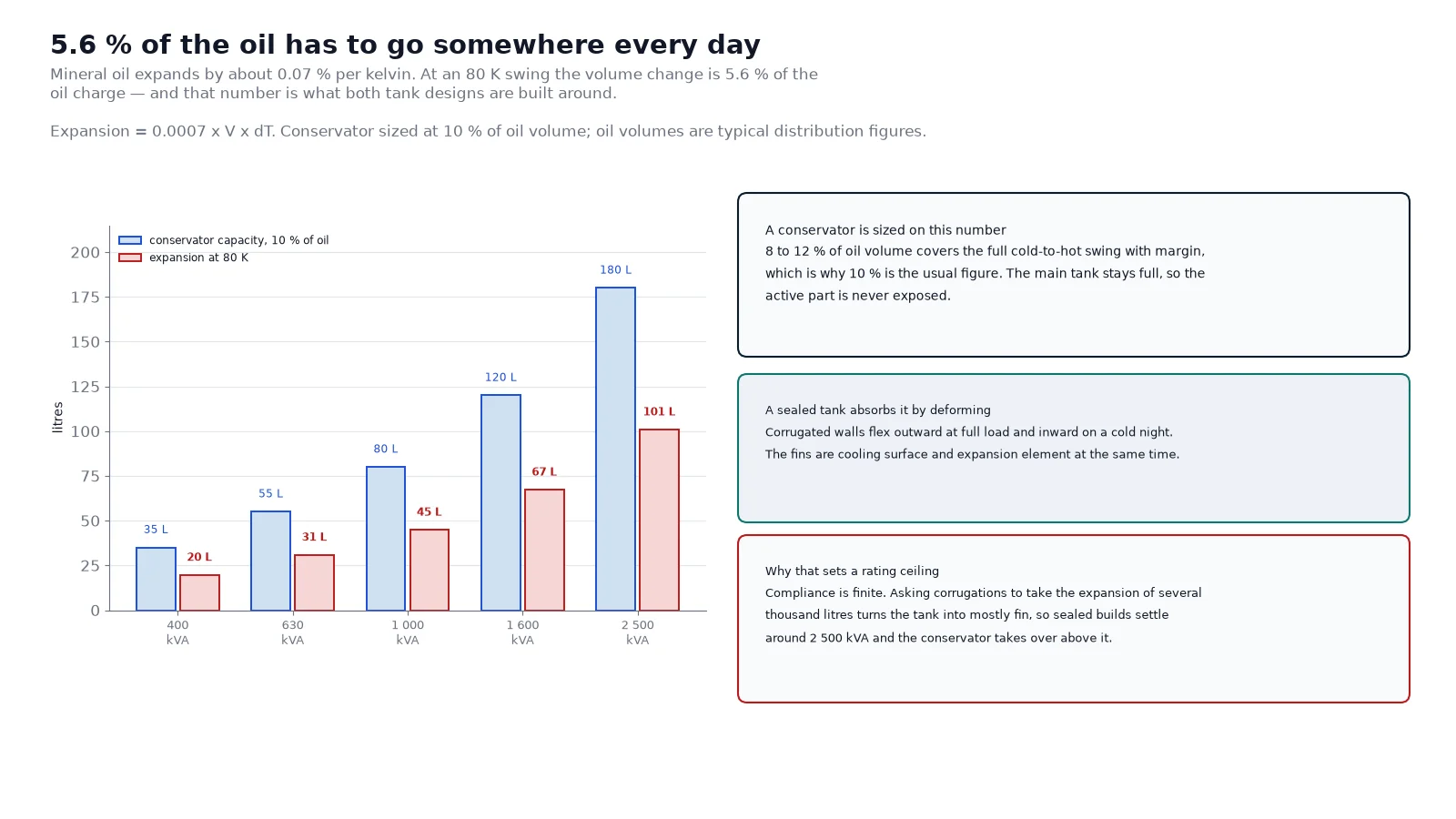
The consequence is a tank that is a pressure vessel by another name. It sees positive pressure at full load and vacuum on a cold night or after a sudden load rejection, and the welds, gaskets and bushings have to hold that cycle for decades. That is why the sealed design is a manufacturing discipline as much as a design choice: the coil and core are the easy part, and the weld quality and the documented pressure test are what determine whether the unit is still sealed in year twenty.
For larger sealed units there is a formal test basis. EN 50708-3-4:2022 defines the special test for hermetically sealed, fully filled tanks above 3 150 kVA: the tank or a representative radiator is cycled 2 000 times between over-pressure and under-pressure to simulate a service life of thermal volume change, followed by a 24-hour static leak test at the manufacturer’s maximum allowable pressure or 1.2 times the highest pressure recorded during the cycling. A supplier who cannot show that test on a large sealed unit has not demonstrated the design.
Side by side
| Point |
Conservator |
Sealed tank |
| Expansion volume |
Dedicated vessel, 8–12% of oil volume |
Flexing corrugations or nitrogen cushion |
| Oil-to-air contact |
Through the breather; none if a bladder is fitted |
None in normal operation |
| Moisture ingress |
Depends entirely on breather condition |
Negligible while the welds hold |
| Routine maintenance |
Silica gel, oil level, gaskets, sampling |
Visual inspection and pressure check |
| Buchholz relay |
Standard — the pipe gives it a home |
Not fitted; pressure relief and sudden-pressure relay instead |
| Oil sampling |
Direct, at the conservator |
Through a drain valve, against internal pressure |
| Practical rating ceiling |
No limit — used to the largest power transformers |
Commonly 2 500 kVA, some builds to 5 000 kVA |
| Voltage ceiling |
All classes |
Around 36 kV in distribution practice |
| Height and footprint |
Taller; conservator may ship separately |
Compact, low profile, container-friendly |
| Field repair |
Straightforward |
Fin damage and resealing need factory attention |
| Failure mode to watch |
Neglected breather, low oil level |
Slow loss of seal, invisible until moisture appears |
Where the sealed design wins
The sealed tank is the right answer when nobody is going to visit the transformer. That covers more projects than it used to.
- Remote, coastal and desert sites. Dust and salt spray attack a breather and its oil cup; a welded tank has nothing to clog. The same logic applies to high-humidity tropical sites, where a silica gel charge can be spent within a season and nobody notices until the oil test comes back wet.
- Pad-mounted and compact substations. No conservator means a lower profile that fits the enclosure, and no oil-level gauge to route to an accessible face.
- Export packing and sea freight. A single sealed envelope with no conservator to drain, brace or ship separately is materially easier to containerise. For projects in the Middle East and Africa where the transformer crosses an ocean before it is commissioned, this is often the deciding factor rather than a preference. The packing and freight rules for oil-filled units are worth reading before the tank type is fixed, because the conservator changes both the crate height and the oil charge.
- Maintenance crews with limited access. If the maintenance schedule will not be followed, a design that does not depend on it is safer than a schedule that looks good on paper.
What the sealed design costs you is visibility. Oil condition has to be inferred from a sample rather than seen through a gauge, and a slow seal failure produces no early symptom until moisture shows up in a laboratory result. Pressure and temperature monitoring partly compensates, but it is a different kind of information from a Buchholz gas accumulation.
Where the conservator still wins
Above a few megavolt-amperes the arithmetic changes hands. The corrugations have a finite compliance; asking them to absorb the expansion of several thousand litres of oil means a tank that is mostly fin, and the design stops being economical well before it stops being possible. From roughly 3 150 kVA upward the conservator is the normal choice, and above 36 kV it is effectively the only one.
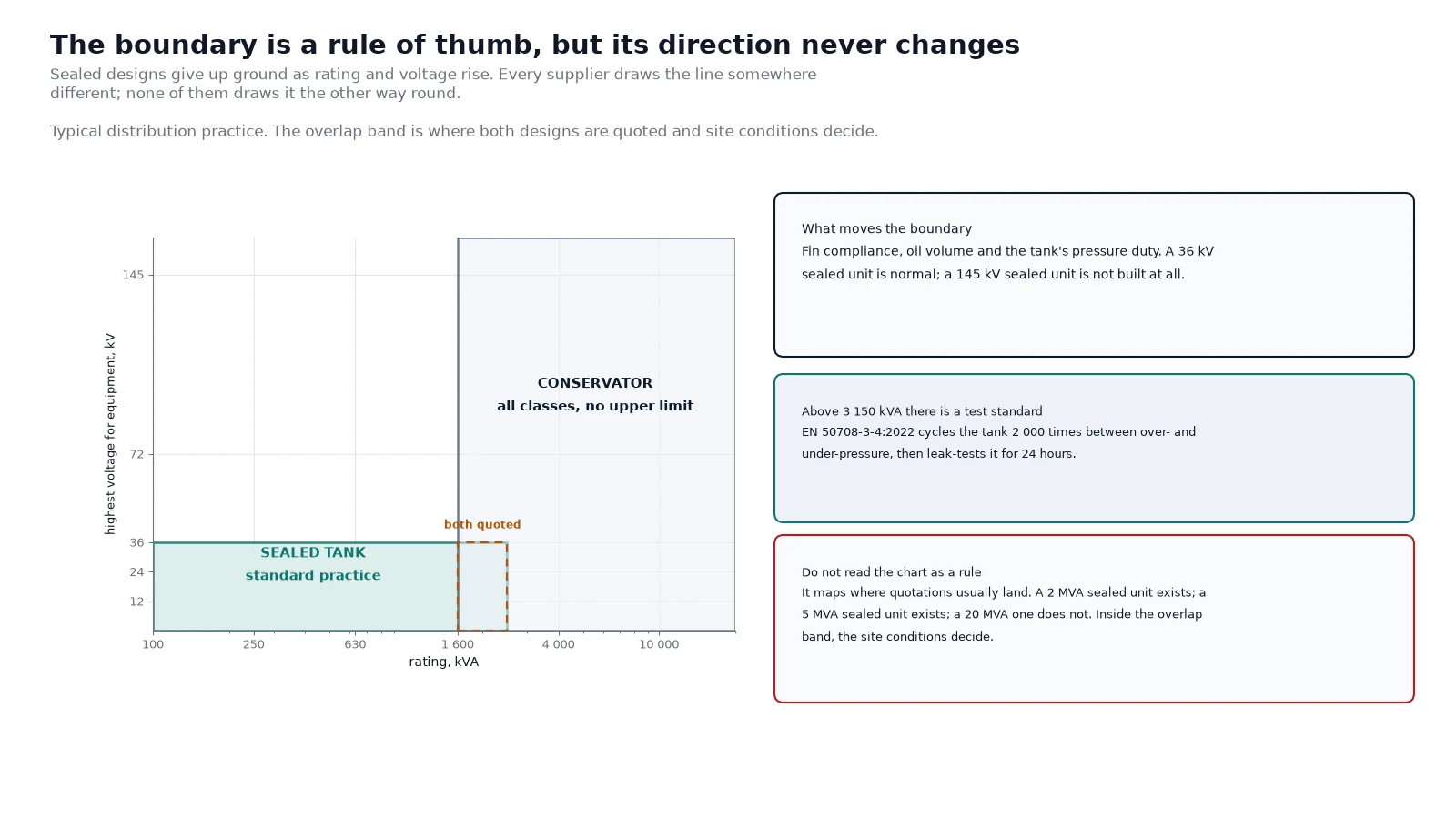
The envelope is a rule of thumb, not a standard, and every supplier draws its own boundary. What does not move is the direction of the boundary: sealed designs give up ground as rating and voltage rise, and the crossover sits in the low single-digit megavolt-amperes for distribution work.
Three other cases pull toward the conservator regardless of rating:
- On-load tap changers. An OLTC has its own oil compartment and its own protection, and the conservator arrangement is the standard way to pipe both.
- Dissolved gas analysis programmes. A utility that runs DGA on a schedule wants straightforward sampling and a Buchholz relay as a first-line indicator. On a sealed unit the same programme is possible but less informative — the DGA interpretation guide is written around samples that were actually taken, and a hard-to-sample unit tends to be a unit that gets sampled late.
- Assets that get worked on. Topping up, filtering, gasket replacement and bushing changes are all easier on a unit with an accessible oil reserve.
What it does to the maintenance budget
On paper the conservator unit has a lower first cost and the sealed unit has a lower running cost. That is true, and it is also too simple, because the conservator’s running cost is almost entirely labour and consumables that a site may or may not actually spend.
For a conservator unit the recurring items are the silica gel charge, the oil cup, the gasket inspections and the periodic oil test. In a temperate, well-staffed substation that is a modest annual cost. In a humid climate with a stretched crew it becomes either a real expense or an unperformed task, and an unperformed task is worse than an expense. The oil-immersed maintenance schedule sets out what the conservator adds over and above the sealed unit’s inspection list. A sealed unit converts all of that into a visual inspection and an occasional pressure check, at the price of a first cost that is usually similar and sometimes higher.
Over twenty-five years the difference is rarely decisive on its own. What decides it is whether the maintenance will happen. That is a site fact, not a design fact, and it belongs in the specification discussion rather than in the price comparison.
What to write in the datasheet
- Tank type, stated explicitly. “Hermetically sealed, corrugated tank, fully filled” or “conservator type with silica gel breather” — not left to the supplier’s default.
- Pressure test. The design pressure and the test pressure, for a sealed unit. Ask for the test record, not just the claim.
- Pressure relief device. Fitted on both types, with a stated set pressure — commonly in the 0.7–1.0 bar range on distribution units.
- Oil preservation details. Breather type and silica gel quantity on a conservator; nitrogen cushion pressure if one is used on a sealed unit.
- Protection accessories. Buchholz on a conservator; sudden-pressure relay and winding temperature trip on a sealed unit if the scheme expects equivalent coverage.
- Oil sampling point. A drain valve with a proper sampling port, on either design. It is a small line item that decides whether DGA is practical.
- Transport condition. Whether the unit ships oil-filled, with a nitrogen charge, or without oil — and what the site has to do before energising.
If the project is a 10 kV or 33 kV distribution unit, the choice is genuinely open and worth arguing about. It should be settled alongside the cooling class, the tap range and the vector group rather than on its own — selecting the oil-immersed type covers how those inputs hang together. If it is a 35 kV feeder transformer with a project-specific tap range and vector group, the 35 kV oil-immersed distribution range is quoted either way, and the tank decision is made once the site conditions are known. For the 25–2 500 kVA, 10–33 kV class, the oil-immersed distribution transformer is built to order with the same input data either way: capacity, voltage combination, tap range, vector group, losses.
FAQ
Is a hermetically sealed transformer really maintenance free?
The oil system is. There is no breather to recharge and no oil level to check, so the routine work drops to a visual inspection and a pressure check. The rest of the unit — bushings, connections, temperature devices, earthing — still needs the same attention as any other transformer.
Why can’t a sealed transformer have a Buchholz relay?
A Buchholz relay needs a pipe with oil flowing to and from an expansion vessel, and a pocket where gas can collect. A sealed tank has neither. Sealed units use a pressure relief device, an optional sudden-pressure relay and temperature devices instead, which protect the unit but give less warning of a slow-developing fault.
Can a sealed tank be used above 2 500 kVA?
It can, and some manufacturers build to 5 000 kVA, but the corrugations must absorb a proportionally larger volume and the tank cost rises faster than the rating. Above roughly 3 150 kVA the conservator is the conventional answer, and EN 50708-3-4 exists specifically to test sealed tanks in that size range.
What happens if the silica gel is never changed?
It saturates and stops absorbing. From that point the conservator breathes untreated air, moisture enters the oil, dielectric strength falls and the paper insulation ages faster. A neglected breather is the single most common reason a conservator transformer underperforms a sealed one of the same age.
Does the tank type affect efficiency or losses?
Not directly. Losses come from the core and winding design, and both designs are assessed to the same efficiency limits. The tank affects temperature rise through its cooling surface, which is why corrugated walls have to be sized as radiators as well as expansion elements.
Which design is better for export to Africa or the Middle East?
Sealed, in most cases. It ships as one envelope without a conservator to drain or brace, it tolerates dust and high ambient humidity without a breather upkeep regime, and it needs no consumables on site. The exception is a large unit where the rating itself forces a conservator.