Transformer Model Numbers Decoded: SCB, SGB, S11, S13, S20
Published: Author: Lisa
A transformer model number is a compressed sentence. In eight or ten characters it states the phase count, the insulation system, the winding style, the loss class, the tank construction, the rating in kVA, and the voltage class. Read it correctly and you know most of what you are buying before the datasheet arrives. Read it as a product name and you will approve the wrong unit.
This guide decodes the codes used on Chinese-built transformers — the SCB, SGB, S11, S13, and S20 families that dominate Asian and African tenders — and shows where those codes stop being reliable. The one rule to carry through everything below: the model number is a catalogue shorthand, the nameplate is the legal description. When they disagree, the nameplate wins.
Why there are two parallel coding systems
Transformers are described in two unrelated languages. The Chinese GB tradition uses a model code, for example S13-M-630/10. The IEC and IEEE traditions describe the same unit as a list of ratings: 630 kVA, 10 kV/400 V, Dyn11, uk 4.5%, ONAN, 65 K rise, sealed tank.
Neither is wrong, and both appear in the same tender documents. Export buyers usually receive a GB model number from the factory and then have to prove to their own engineer that it satisfies an IEC specification. That translation is where most clarifications get stuck, so it is worth learning the code rather than treating it as a part number.
Decoding the letters
The letters come first and describe construction. They are mostly consistent across manufacturers, with a few local variations.
Letter
Meaning
What it tells you
S
Three-phase
Almost every distribution unit. Replaced by D for single-phase.
C
Cast resin insulation
Epoxy-cast dry-type, indoor, no oil.
G
Dry-type, open or ventilated
Also dry-type, but not resin-cast; usually Class H impregnated.
B
Foil winding
Low-voltage winding made from foil rather than round wire.
M
Sealed tank
Hermetically sealed oil tank, no conservator.
Z
On-load tap changer
Regulates while energized. Its absence means an off-circuit changer.
F
Forced cooling
Fans fitted; capacity rises when fans run.
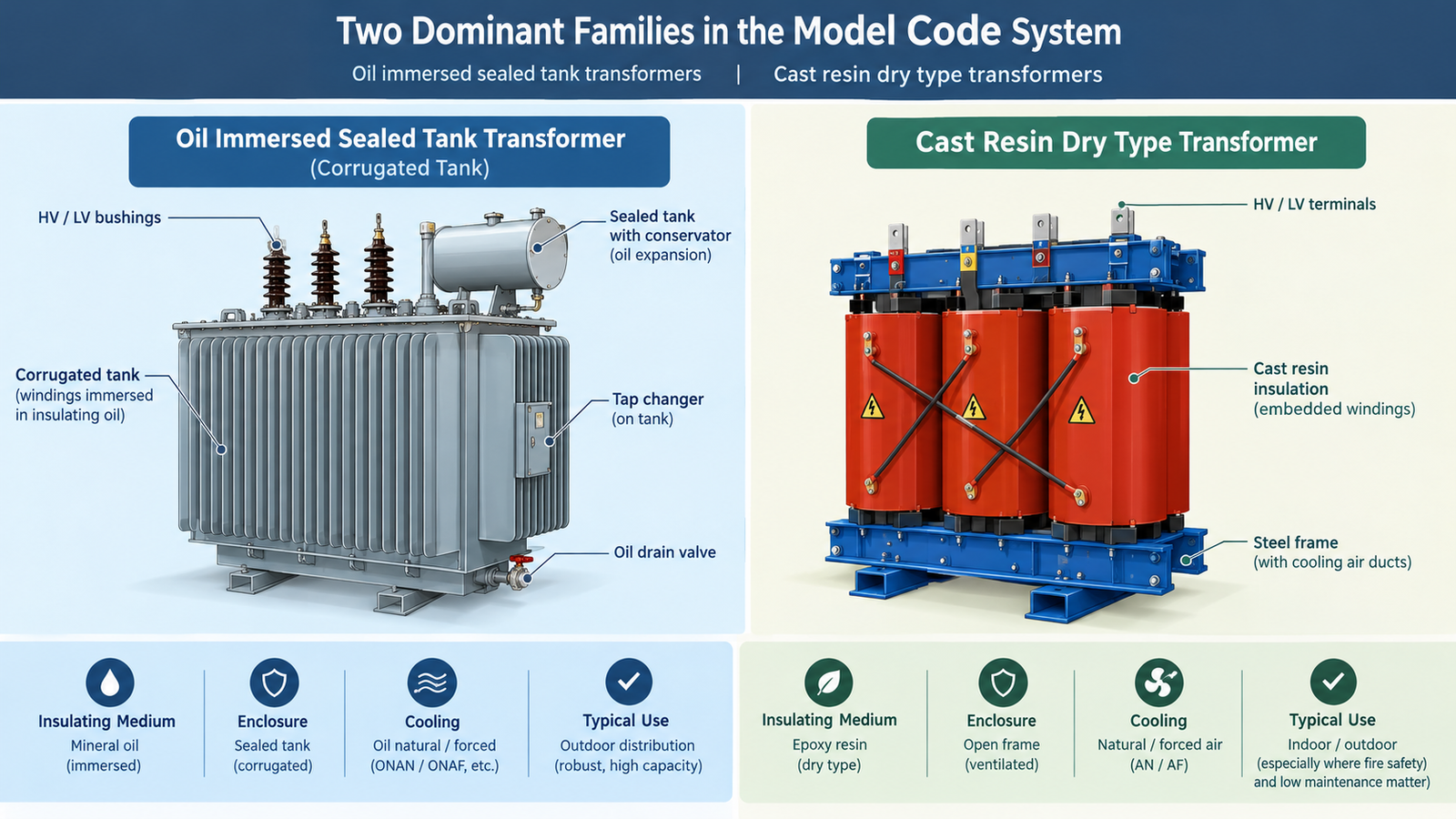
Two families matter most in practice. SCB is three-phase, cast-resin, foil-wound dry-type. S11 or S13 with no C or G is a three-phase oil-immersed unit. If a code contains both C and B, it is a cast-resin dry-type with a foil LV winding; if it contains G, it is a different dry-type construction that is often cheaper and more sensitive to humidity. The transformer types overview puts these families side by side.
Decoding the numbers
The number in the middle is the loss code, sometimes called the performance level. Higher means lower loss. Across the Chinese catalogue the sequence runs roughly 7, 9, 10, 11, 13, 15, 16, 18, 20, with each step representing a design generation with better core steel, lower flux density, or improved winding geometry.
Three cautions make that sequence usable rather than misleading.
The numbers are not linear. The gap from 10 to 11 was small; the gap from 13 to 18 is large. Treat them as generations, not as a scale where 20 is twice as good as 10.
They are not comparable across families. An S13 (oil) and an SCB13 (cast resin) share a number but nothing else, because the loss tables differ by cooling medium and by the standard that governs them.
They are not a compliance statement. A model number cannot prove grade 1, 2, or 3 under GB 20052-2020, nor DOE compliance in the US. Only declared loss values and a test report do that.
Reading the tail: kVA and voltage class
After the letters and the loss code comes the rating, written as capacity/voltage class: -630/10 means 630 kVA with a 10 kV high-voltage winding. The low-voltage value is usually omitted because 400 V is the default for Chinese distribution practice; on export orders it must always be stated explicitly, since 380 V, 400 V, 415 V, 440 V, and 480 V all appear in real projects.
This is also where buyers make arithmetic errors. A unit marked -1000/10 is 1,000 kVA at 10 kV class, not 1,000 kVA at 1,000 V, and the “/10” never means a 10:1 ratio. The ratio is set by the HV and LV voltages, and the kVA calculation behind the choice is covered in the transformer sizing and kVA calculation guide.
Worked examples
Model code
Plain English
Typical use
S11-M-400/10
Three-phase oil-immersed, sealed tank, loss class 11, 400 kVA, 10 kV class
Standard distribution, older specification
S13-M-630/10
Three-phase oil-immersed, sealed, loss class 13, 630 kVA, 10 kV
Current volume distribution grade
S20-M-1000/10
Three-phase oil-immersed, sealed, loss class 20, 1,000 kVA, 10 kV
Low-loss distribution, utility specification
SZ11-10000/35
Three-phase oil-immersed with on-load tap changer, 10 MVA, 35 kV
Substation transformer with voltage regulation
SCB13-1000/10
Three-phase cast-resin dry-type, foil winding, loss class 13, 1,000 kVA, 10 kV
Indoor distribution, commercial and data center
SGB10-800/10
Three-phase ventilated dry-type, foil winding, loss class 10, 800 kVA, 10 kV
Indoor dry-type where cost dominates
D11-M-50/10
Single-phase oil-immersed, sealed, loss class 11, 50 kVA, 10 kV
Pole-mounted rural distribution
Notice how much the model code leaves out. SZ11-10000/35 tells you there is an OLTC but not its range. S20-M-1000/10 tells you nothing about impedance, vector group, or cooling. Those omissions are why the code is a starting point, never an order.
What the model number does not tell you
Eight parameters decide whether a transformer fits the system, and none of them appear reliably in the model code:
Vector group — Dyn11, Yyn0, Yd11. Wrong group means parallel operation is impossible and protection settings are wrong.
Impedance uk% — drives downstream fault levels and breaker ratings.
Cooling class — ONAN, ONAF, AN, AF. Two units with the same code can have different capacity when fans run; the details are in the cooling class guide.
Temperature rise and insulation class — 65 K on oil, 80 K or 100 K on dry-type, on Class F or H insulation.
Tap range and tap changer type — ±2×2.5% off-circuit or a full OLTC range.
Enclosure and IP rating — IP20 indoors versus IP54 outdoor enclosures change the cooling and the derating.
Winding material — copper or aluminium. The model number normally does not distinguish them, and the price difference is large.
Altitude and ambient — a 1,000 m standard design derates above that, and a site at 2,000 m needs a declared correction.
If any of these is missing from a quotation, the quotation is not yet comparable with another one. The nameplate ratings guide explains where each appears physically on the unit, and the dry-type specification guide shows the equivalent fields for cast-resin units.
Model code versus nameplate: the cross-check
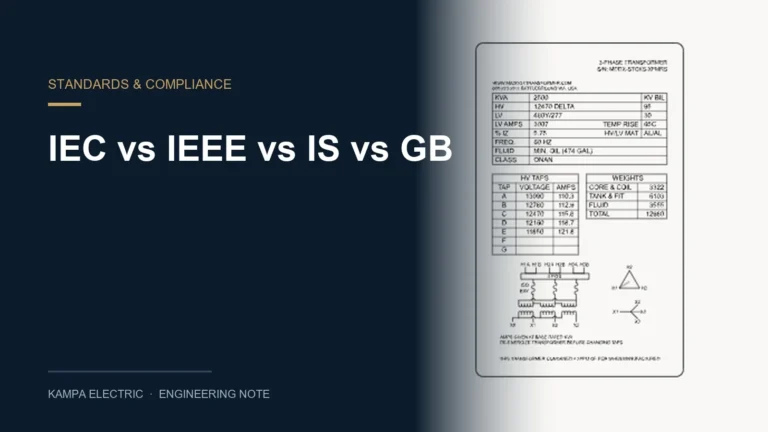
The nameplate is what you test against, insure, and argue about in a warranty claim. Cross-check it against the model code in four places.
Check
Model code says
Nameplate must confirm
Rating
S13-M-630/10
630 kVA, 10,000/400 V, 50 Hz
Connection
Nothing
Dyn11, or whichever group was ordered
Impedance
Nothing
uk = 4.5% at 75 °C, principal tapping
Losses
Class 13
P0 and Pk in watts, with reference temperature
If the nameplate omits losses or impedance, that is a documentation failure, not a simplification. Ask for the values in writing before acceptance testing.
How to write a model number in an enquiry
Do not send a bare code. Send the code plus the five items that decide the design, and you will cut at least one round of clarification out of every order.
Model and rating — for example SCB13-1000/10, stated with kVA and voltage ratio.
Vector group and impedance — Dyn11, uk 6%, with the tolerance you will accept.
Tap range — ±2×2.5% off-circuit, or the OLTC range and step.
Environment — indoor or outdoor, IP rating, ambient maximum, altitude.
Standard and marks — IEC 60076-11 or GB 1094.11 for dry-type; UL 1561 at or below 600 V and UL 1562 above 600 V for North America.
Five traps in model codes
Dropping the M. S11-400/10 is not the same as S11-M-400/10: the M denotes a sealed tank. On the same rating, that is a different tank design, different oil volume, and a different maintenance regime.
Confusing SCB with SGB. Both are dry-type, but cast resin and ventilated construction behave differently in humid or dusty rooms. Buying on the code alone risks the wrong technology.
Assuming a suffix means an upgrade. Duplicate product pages often carry -2 or a similar suffix, which usually means a re-uploaded listing, not a second design.
Reading 13 as a voltage. It is a loss class. Voltage class sits after the slash.
Using the code as the specification. Two factories can quote “SCB13-1000/10” with different losses, different weight, and different core steel. The code does not adjudicate.
Conclusion
Transformer model codes are efficient once you know the grammar: letters for construction, a number for loss class, then kVA over voltage class. They are also silent on the eight parameters that decide whether the unit works in your network. Read the code to screen offers quickly, then compare the datasheet field by field — rating, vector group, impedance, losses, cooling, temperature rise, enclosure, and environment.
If you are comparing several model codes against an IEC or IEEE specification, the Kampa team can translate both directions and confirm which code actually satisfies your specification. For the cost implications of each family, the oil-immersed cost breakdown is the natural next read.
FAQ
What does S11 mean on a transformer?
S11 means a three-phase oil-immersed transformer in loss class 11. The S is three-phase, the 11 is the loss generation. It says nothing about kVA or voltage, which appear after the hyphen as capacity over voltage class.
What is the difference between SCB and SGB?
Both are three-phase dry-type units with foil windings. SCB uses cast epoxy resin insulation; SGB is an open, ventilated dry-type design. Cast resin tolerates humidity and dust better, while ventilated units are usually cheaper.
Does a higher number mean a bigger transformer?
No. The number is the loss class, not the size. A higher class usually means more core material at the same kVA, so it may be physically larger, but the rating is the number before the slash.
What does the M in S13-M-630/10 stand for?
M means a sealed, hermetically closed tank with no conservator. It is a construction detail that affects oil expansion handling and maintenance, not the electrical rating.
How do I convert a Chinese model number to an IEC description?
Expand each element: SCB13-1000/10 becomes a 1,000 kVA, 10 kV/400 V, three-phase cast-resin dry-type transformer with foil windings and loss class 13. Then add the vector group, impedance, cooling, temperature rise, and enclosure from the datasheet, because the model code does not carry them.